How to Choose an SEO Agency: 7 Things to Check
,
November 16, 2026
Choosing an SEO agency isn't just about finding someone who can improve your Google rankings. You need a team that understands your business, knows how to reach potential customers, and can explain where your money goes.
Some SEO companies promise more traffic without showing how those visitors turn into leads or sales. Others offer services your website may not even need.
In this article, you'll learn how to choose an SEO agency by checking its experience, past results, services, reporting, and pricing before you sign a contract.
TL;DR
Here is how to choose an SEO agency:
- Define your SEO goals and business needs
- Look for SEO agencies with relevant industry experience
- Review their SEO case studies and client results
- Understand their SEO strategy and services
- Check how they measure and report SEO performance
- Evaluate their communication and team expertise
- Compare SEO pricing, deliverables, and contract terms
For B2B SaaS companies, ABHMedia offers done-for-you SEO services focused on attracting qualified leads, demo requests, trial sign-ups, and paying customers.
7 Things to Check to Choose the Right SEO Agency for Your Business
Before choosing an SEO agency, you need to do the following:
1. Define Your SEO Goals and Business Needs
Start by identifying your SEO needs and setting clear goals, such as increasing online sales by 20% or doubling qualified demo requests within a year. Use conversion data to track how many visitors become customers rather than focusing only on organic traffic or rankings for specific keywords.
Your business model will help you decide which services to prioritize:
- Local businesses: Improve visibility in nearby searches and attract more calls or visits.
- Ecommerce stores: Fix product pages, site speed, and indexing problems.
- B2B SaaS companies: Create comparison pages and content that attracts potential buyers.
Talk with your internal team about existing website problems before hiring anyone. You may only need technical fixes or improvements to one landing page.
Choose a one-time project for specific fixes or ongoing support if you need regular content, updates, and SEO work.
2. Look for SEO Agencies With Relevant Industry Experience
Not all SEO companies understand the same customers or sales processes. Look for agencies with a proven track record in your industry and ask how they've helped similar businesses.
For example, a local SEO specialist should know how to manage your Google Business Profile, improve location pages, and attract nearby customers. Ecommerce experts need experience with product catalogs and technical problems. B2B SaaS agencies then should understand software comparisons, demo requests, and longer sales cycles.
Relevant experience helps an agency understand your target audience and the terms potential customers use when searching. However, previous clients alone don't prove that a team can deliver results.
Ask for examples of current work and check whether the content answers real customer questions. Finding the right SEO company means choosing a team that understands your market and can explain its approach. The right agency should back up its recommendations with research.
3. Review Their SEO Case Studies and Client Results
Go beyond client testimonials and ask for case studies that explain the client's original problem, the work completed, and the results.
A useful case study would show how the agency fixed broken redirects or indexing errors and how performance changed afterward.
Check these details:
- Starting point: Previous traffic, leads, and sales.
- Actions: Specific technical fixes, content updates, or link-building work.
- Results: Changes in conversions, revenue, and search visibility.
- Timeline: How long the campaign took to produce results.
Don't judge performance only by keyword rankings or appearances in search results. More visitors won't guarantee business growth if they never purchase anything.
Reputable agencies may provide client references with permission. Ask those clients whether the team met deadlines, explained problems clearly, and helped generate qualified leads or sales.
4. Understand Their SEO Strategy and Services
A good agency should explain its search engine optimization plan in simple terms and show how its SEO services address your website's problems.
Ask how they handle four main areas:
- Technical SEO: Technical audits should find issues with site speed, mobile usability, broken links, and page indexing. Agencies should prioritize technical SEO when these problems stop Google from reading important pages. Structured data may help eligible pages appear with extra details in search.
- Keyword research: A team should study search intent to find terms your potential customers use when comparing products or looking for solutions.
- Content strategy: Experienced content strategists should identify content gaps, plan useful content, and handle content creation. Ask whether they offer content creation and help with optimizing content already on your site, including title tags. Avoid agencies that publish generic content without checking its accuracy.
- Link building: Skilled link building specialists should seek high-quality backlinks from relevant websites rather than buy large link packages. Such links can support your site's reputation, but domain authority scores don't directly determine Google rankings.
5. Check How They Measure and Report SEO Performance
Before signing a contract, ask how the agency will measure success and explain the results of its SEO work.
A useful report should track organic visitors, conversions, qualified leads, and sales when possible. Changes in search rankings can help explain performance, but higher positions don't always lead to more customers.
Ask which SEO tools the agency uses. Google Search Console shows clicks, impressions, and search queries. Google Analytics 4 tracks user behavior, including page visits and actions such as purchases or form submissions.
Monthly reports should explain what changed, what the team completed, and what it plans to do next. For example, an agency might report that it fixed indexing errors on five product pages and explain whether those pages gained search traffic afterward.
Regular meetings should give you time to ask questions about results and discuss changes to the strategy.
6. Evaluate Their Communication and Team Expertise
Before hiring an agency, ask to meet the people who will actually work on your website. A strong sales presentation means little if you don't know who will manage your project afterward.
SEO experts should explain who handles each part of the work. Depending on your needs, SEO specialists may include a technical expert for website errors, a writer for content, and a strategist who plans priorities and reviews results.
Some agencies use an in-house team, while others work with freelancers or outside experts. Either approach can work when the agency checks quality and takes responsibility for deadlines.
Find out who your main contact will be, how often you'll meet, and how quickly the team usually answers questions. Ask whether you can review tasks through a shared project board.
Clear responsibilities and regular updates make it easier to spot delays before they affect your website.
7. Compare SEO Pricing, Deliverables, and Contract Terms
Set your SEO budget before comparing proposals, then check exactly what each agency includes in its price.
Agencies commonly offer three pricing options:
- Monthly retainers: Best for ongoing content, technical improvements, and regular performance reviews.
- Project fees: A fixed price can be cost-effective for a website audit, migration, or specific cleanup.
- Hourly consulting: Useful when your team needs expert advice but can complete the work itself.
An expensive agency isn't automatically better. Yet, a more expensive agency may offer better value if its fee covers writing, technical fixes, and implementation rather than advice alone.
Request a written list of deliverables, including who will complete each task and whether extra charges apply.
Before signing, review the contract length, cancellation terms, and ownership rules. Keep full data access to your website, analytics accounts, and published content even after the agreement ends.
What Are the Red Flags When Choosing the Best SEO Agency?
Watch for these warning signs before hiring an SEO agency, especially when its promises sound too good to be true:
- Guaranteed rankings: Avoid agencies that promise first-page positions within weeks. Google doesn't guarantee rankings, and algorithm changes can affect how websites appear in search engines.
- Secret methods: A good agency should explain its approach to content, technical fixes, and link building. Be careful when an SEO partner refuses to explain its work or claims special access to Google.
- Cheap backlink packages: Firms that sell hundreds of links may use spam networks that violate Google's search policies and harm your rankings.
- Limited account access: A good SEO company should let you control your domain, website, and analytics accounts.
- Generic proposals: Question agencies that recommend identical services without reviewing your website or business goals.
- Traffic-only reports: Look for reports that connect SEO results to qualified leads, sales, and other business outcomes.
Leave Your SaaS SEO Strategy and Execution to ABHMedia
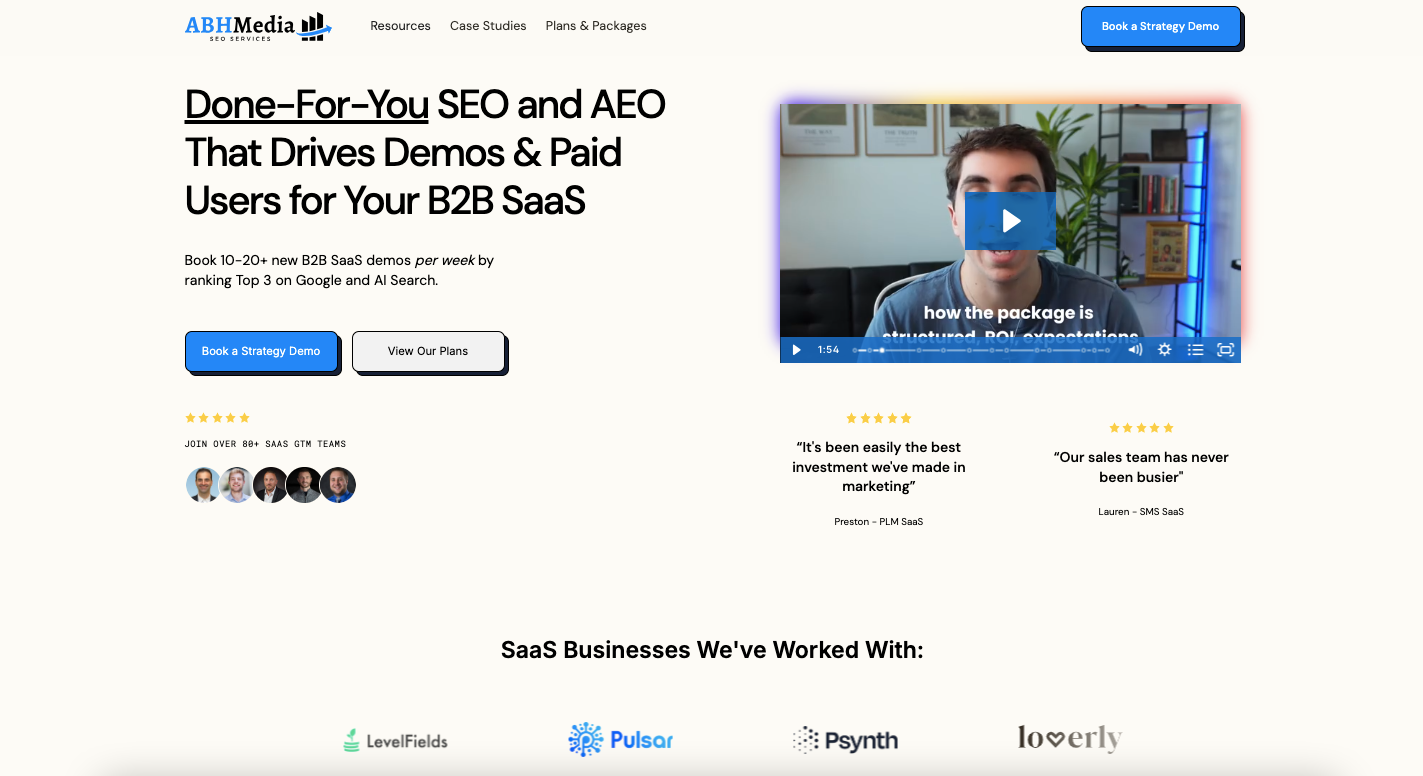
ABHMedia is a B2B SaaS SEO agency that helps software companies attract potential customers through Google and AI search platforms. We handle the SEO process for you, from keyword research and technical fixes to content writing and link building.
Our work focuses on searches that can lead to product demos, free trials, qualified leads, and paid users rather than traffic numbers alone.
Start With an SEO Strategy Based on Your SaaS Customers
We begin with a strategy session to understand your software, ideal customer profile (ICP), and business goals. Our team then researches the keywords potential buyers use when comparing tools, looking for specific features, or searching for solutions to their problems.
For instance, a workflow automation platform may benefit from comparison articles, integration pages, and guides about specific tasks. Such pages can attract visitors who already have a reason to consider the product.
We use that research to build a content calendar and decide which pages to create or improve first.
Fix Technical Problems Before Scaling Content
Our team conducts an effective SEO audit to identify problems that may stop Google from finding, reading, or indexing important pages.
We review technical issues and provide fixes based on your website's needs. Our services include technical SEO, content optimization, and website improvements.
For SaaS companies with larger websites, we offer programmatic SEO consulting and implementation. We can create pages for relevant product use cases or integrations when the business has enough useful information to support them.
Create Content and Build Relevant Backlinks
ABHMedia handles SEO content writing, existing page updates, and link-building campaigns.
We focus on keywords with commercial or transactional intent, such as software comparisons and searches for specific solutions. Our writers plan each page around the topic and the questions potential customers want answered rather than using the same word count for every article.
Our link-building approach favors relevant placements over large packages of low-quality backlinks. We select pages that need support and report on the links our team earns.
Track Results and Keep Ownership of Your Work
Our monthly reports cover SEO performance and conversions, helping you see whether your website attracts visitors who take useful actions.
We've worked with SaaS companies including Activepieces, TextUs, Briefpoint, and Odin AI.
ABHMedia offers one-time SEO setup and monthly plans for different stages of growth. Our services are done for you, so your team can focus on the product while we handle SEO tasks.
We don't require long-term contracts, and you retain ownership of the content and other assets we create.
FAQs About How to Choose an SEO Agency
What is the 80/20 rule in SEO?
The 80/20 rule in SEO suggests that roughly 80% of your results may come from 20% of your efforts. It's a general principle, not a fixed formula. Focus on pages, keywords, and technical fixes that have the greatest potential to bring qualified leads and sales.
Is SEO dead now with AI?
No, SEO isn't dead because of AI. Google still uses organic search results, and people continue to search for products, services, and answers. AI search features have changed how users find information, so businesses should focus on accurate, useful content that answers specific questions.
How much does an SEO agency cost?
SEO agency pricing depends on your website size, competition, and services. Monthly retainers commonly range from around $1,500 to $7,500 or more, although prices vary widely. One-time audits and consulting projects may cost less depending on the work required.
Is SEO still worth it in 2026?
Yes, SEO can still be worth the investment in 2026, especially for businesses whose customers use search to compare products or find solutions. A strong strategy can bring qualified visitors without paying for every click, although results take time and depend on competition, website quality, and execution.