


How to Build a Profitable SaaS SEO Strategy (2026 Guide)
,
February 26, 2026
Many SaaS founders think that search engine optimization (SEO) means writing blog posts every week.
However, publishing several blog posts, especially generic ones, is not enough to attract website traffic and get demos for your Software-as-a-Service (SaaS) product.
You should create intent-focused web pages that will drive conversions, not just traffic.
You also need to think about your website's structure, the keywords to use, the links to include, and the user experience.
In this guide, you'll learn how to develop a successful SaaS SEO strategy that will turn it into your most profitable marketing channel.
TL;DR
- To build a profitable SaaS SEO strategy, fix technical issues first, target buyer-intent keywords, map content to the marketing funnel, earn high-quality backlinks, and optimize for conversions.
- The key elements of any strong SaaS SEO strategy include technical SEO, content, on-page optimization, off-page SEO, and user experience.
- SaaS SEO is different from traditional SEO because it addresses long buying cycles, subscription-based retention, and several stakeholders.
- ABHMedia helps SaaS companies rank for high-intent keywords and turn organic traffic into qualified demos and paid users.
How SaaS SEO Differs from Traditional SEO
SaaS SEO is not your typical search optimization.
Traditional SEO often focuses on local services or e-commerce stores. The goal is to rank a website and improve search visibility.
SaaS SEO works differently because it doesn't just focus on search rankings. It involves guiding potential customers from problem awareness to product evaluation and, finally, conversion, whether that's a trial sign-up or a demo.
This is important because SaaS buyers rarely purchase after seeing your product online. They conduct extensive research, compare different tools, read reviews, and check pricing.
The buying cycle is longer. And the decision often involves several stakeholders, not just one person.
Your SaaS SEO strategy must match this behavior. You are not just ranking for organic traffic. You are also optimizing for profit.
To succeed in SaaS SEO, you should build trust, show expertise, and support buyers at every stage of their decision process.
Key Elements of an Effective SaaS SEO Strategy
Every successful SEO strategy stands on a few core pillars. Let’s discuss them in detail below.
Technical SEO
Technical SEO is the foundation of your SaaS website. If search engines cannot crawl or index your site, you won't rank. Simple as that.
Technical SEO means optimizing your website's technical aspects so it performs better in search engine results pages (SERPs).
These aspects include site architecture, crawlability, speed, performance, mobile-friendliness, security, and data structure.
Many SaaS sites struggle with one or more technical issues, although most SaaS founders aren't aware of them.
For example, you might have duplicate content that confuses search engines, improper HTTP/HTTPS security that hurts organic rankings, or poor mobile optimization that causes users to prematurely leave your website. Even a small detail like your URL structure can affect SEO performance.
In other words, a slow or messy website will hold your SEO strategy back, no matter how strong.
It's important to fix these technical issues because they directly impact online visibility.
Content
Content drives SaaS SEO. But don't just write any generic content because it won't rank your website.
This is actually one of the most common mistakes of SaaS businesses. Many have already put out plenty of blog posts in hopes of attracting customers. When they don't see results, they wrongfully conclude that SEO is not working.
The problem is not SEO, but your content strategy.
You should create content that matches the search intent. That means understanding what your ideal customers are searching for.
Are they comparing SaaS platforms? Looking for pricing? Searching for solutions to a problem?
For example, if your target audience is comparing platforms, you can write a comparison article or a blog post that talks about "alternative" tools.
If users are aware of a problem but not a solution, you can create "what is (topic)" or "how-to" guides. Focus on building trust with users, rather than selling your SaaS product, but that is the end goal.
Every piece of content should serve a purpose to attract the right audience, who are likely to turn into paying customers.
On-Page SEO
On-page SEO is the process of optimizing individual web pages so they rank and convert users.
Search engines need clear signals. What is your page about? Who is it for? What problem does it solve? If your messaging is vague, search engine rankings may suffer.
Each page should target one main keyword or topic. Your title tag should state it clearly. Your headers must support it. And your content needs to stay on topic.
Internal links are also important because they connect related pages and help search engines understand your site.
But on-page optimization is not just for search engines. It’s also for your users.
On-page SEO makes your pages more intuitive, accessible, and well-organized. Users can quickly find the information they need, which reduces frustration and increases trust.
Off-Page SEO
Off-page SEO refers to all the actions you do outside your website that impact your search rankings.
While on-page SEO focuses on your content and structure, off-page SEO builds reputation and authority.
Search engines want to know if others trust your SaaS brand. One of the main signals they use is backlinks.
Backlinks are links from other websites pointing to your site. When other authoritative websites link to your web pages or blog posts, it shows that your content has value.
This is important if you want to rank higher in the SERPs. According to Backlinko, pages that rank in the number 1 position have about 3.8 times more backlinks than pages ranked number 2-10.
Most SaaS companies earn backlinks from guest posts, industry publications, partnerships, and data studies.
Digital PR also helps boost your reputation in the SaaS industry. The stronger your reputation is, the easier it is to rank in search engine results.
User Experience
User experience, or UX, describes how simple, clear, and helpful your website feels to users.
UX is an important SEO pillar because it affects both rankings and conversions.
If users visit your SaaS website and feel confused, they leave. If they cannot find pricing, features, or the sign-up button, they do not convert.
Search engines track user behavior. Over time, poor engagement and high bounce rates can negatively affect SaaS SEO performance.
Make sure your website is easy to use and navigate to keep visitors on your site longer. Pages should also load fast, and content must be easy to read.
Don't forget to optimize for mobile devices because most users search online using their phones. Build a mobile-first, responsive web design to improve the user experience.
How to Create a Profitable SaaS SEO Strategy
Follow this step-by-step guide to develop a profitable SEO strategy for your SaaS business.
Step 1: Audit Your SaaS Website and Fix Technical SEO Issues
Before you create content or research keywords for your SEO strategy, you should conduct a website audit.
A website audit reviews your site’s health. It shows what is working and what is broken. If your foundation is weak, your SEO efforts won't be maximized to reach their full potential.
Start by checking crawl errors. Use tools like Google Search Console to find pages that are not indexed.
You should also review your site structure. Can search engines easily understand your product pages, features, and blog content?
Now that you know what's wrong, you should promptly fix these technical issues.
If you encountered a broken page (404 error), apply a 301 redirect to a relevant and updated web page.
Noticed that your site is slow? Compress large images to improve page speed.
You should also submit an updated sitemap to search engines, especially if you have a new site or a large site with over 500 web pages.
This sitemap lists all the important pages on your website. It helps search engines find and understand your content more efficiently.
To further improve page understanding and SEO performance, you can add a schema markup to your website’s code. It converts plain text into structured information.
Step 2: Conduct Keyword Research
Selecting keywords is one of the first steps in building your SaaS SEO strategy. If you target the wrong terms, your content will attract the wrong audience.
Many SaaS companies make the mistake of choosing keywords with high search volume. Website traffic goes up, but leads do not. That’s because volume does not always equal buying intent. A keyword can bring thousands of visitors who will never sign up.
So instead of targeting high search volume phrases, focus on relevant keywords that match your target buyer’s search queries.
Think about what your ideal customer types into Google when they are looking for a solution. Search terms like "best project management software" and "WordPress vs. Squarespace" show strong buying intent.
You should also look for low-hanging fruit keywords. These are long-tail phrases with decent traffic but low competition.
Targeting these terms first with your blog posts and landing pages can bring early wins and steady growth while you build authority.
Use tools like Google Keyword Planner or Semrush's Keyword Magic Tool to find relevant keywords with strong user intent.
Step 3: Analyze Competitors
You are not the only SaaS company investing in SEO. There's a big chance that your competitors are already ranking for keywords you want. That's why it's important to study them.
Go to their websites and read their blog posts, product pages, and comparison pages. What topics are they covering? Which keywords are they targeting? Pay attention to how they structure their content and how they match user intent.
Next, run a keyword gap analysis using SEO tools like Semrush or Ahrefs. These tools show you which keywords your competitors rank for.
Look closely at pages that bring them traffic. Are they targeting “best software” keywords, industry-specific terms, or competitor comparisons? These insights can guide your own content strategy.
Do not copy their content. Instead, find gaps. Write more valuable content that answers the user intent clearly.
Competitor analysis shortens your learning curve. It shows you what already works in your industry and where you can compete for meaningful search visibility.
Step 4: Develop a Content Marketing Strategy
Now that you have your keywords, it's time to build an effective SaaS content marketing strategy.
Set goals for each keyword you want to target. Do you want to receive demo requests, get sign-ups, or build online authority? Define what success looks like before you create content.
Next, identify your audience and their pain points. Who is searching this keyword? It could be a founder, a marketing lead, or a technical buyer. Sometimes, it could be several people or business types.
For example, if you sell compliance inspection software, you may cater to food, assisted living, and manufacturing facilities. It's important to understand what problem your target audience is trying to solve to develop effective content.
Then, decide on the types of content you will create, depending on your goals and audience.
For example, if your goal is to persuade buyers, write in-depth comparison articles. Show how your SaaS product stacks up against competitors. Address pricing, features, and use cases.
Those who want to build authority in their space should create a shareable infographic with useful data. Visual content can attract links and brand mentions.
Step 5: Map Keywords and Content Strategy to the SaaS Marketing Funnel
The SaaS marketing funnel describes the stages a buyer goes through before becoming a customer. It includes awareness (top of the funnel), consideration (middle of the funnel), and decision (bottom of the funnel).
To build a profitable SaaS SEO strategy, you must align keywords and content with user intent at each stage.
Not every site visitor is ready to start a product trial. Some are just learning about their problem. After finding out the solution, they start comparing tools. And once they've thoroughly reviewed options, they are ready to buy.
However, the SaaS marketing funnel is not linear. Do not assume every visitor starts at the top and moves step by step to the bottom. Some users land on your pricing page first. Others arrive through a "how-to" guide.
That’s why your content should support different entry points. When your keywords match stages of the funnel, your SaaS business attracts users at every level of readiness.
Here's a closer look:
Awareness Stage (Top of the Funnel)
At the awareness stage, users know they have a problem. But they may not know the right solution yet. They are searching for answers, not products.
For example, someone might search “how to manage remote teams better” or “why is my churn rate high?” These search queries show pain points, not product intent. Your job is to meet them there.
Create blog posts with informational intent. Explain the problem in simple terms, share common causes, and offer practical advice. Show that you understand their situation. When readers feel understood, they trust you more.
Do not push your SaaS product too hard at this stage. Instead, guide users toward possible solutions. Introduce your category naturally. Help them connect their problem to the type of software you offer.
Consideration Stage (Middle of the Funnel)
At the consideration stage, users know a solution exists and want to understand their options.
They may search for terms like “best SEO tools for SaaS startups” or “AI chatbot comparison.” These keywords show strong user intent.
Your content should focus on how your SaaS product works. For example, you can create comparison pages or write detailed feature breakdowns. Explain how your software solves specific pain points.
You can also address common objections. Be clear about who your product is for and who it is not for. Buyers want clarity before they move forward.
Decision Stage (Bottom of the Funnel)
Users at the decision stage are close to taking action. They already understand the problem and possible solutions. Now they want to know if your SaaS product is the right choice.
Common keywords to target include “[your product] pricing,” “[your product] reviews,” or “[competitor] alternative.”
Develop content that removes a user's doubt. Make pricing clear. Share case studies and testimonials. Show proof that your SaaS product works.
It's also important to include calls to action (CTAs) to drive engagement and conversions. Make it obvious how to start a trial or request a demo.
Step 6: Build Your Topic Clusters
Topic clusters organize your content around one main theme. Instead of writing random articles, you group related topics together.
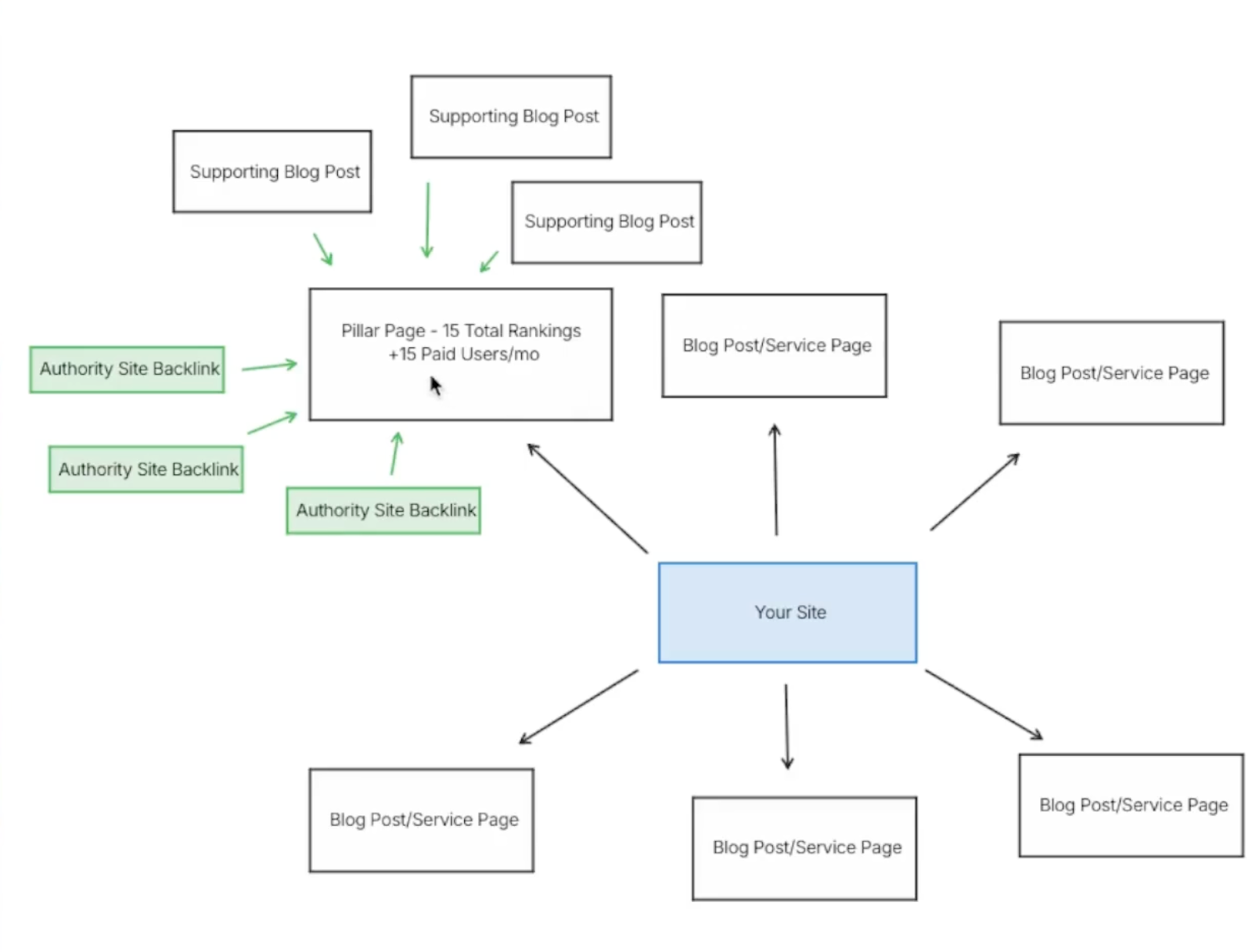
Each cluster has one pillar page. This page targets a broad keyword and covers the topic in depth. It acts as your main resource.
Then, you create several subtopic pages that explore specific angles. These cluster pages link back to the pillar page. The pillar page also links to them.
This internal linking strategy helps search engines understand your expertise. It shows that you cover a subject fully, not just once.
In most cases, reserve your broadest and highest volume term for the pillar page.
For example, a B2B SaaS company selling onboarding software might build a pillar page targeting “user provisioning.” Supporting cluster content could include “user provisioning software,” “user provisioning best practices,” and “automated user provisioning.”
The pillar page eventually gets three authoritative backlinks and starts ranking for several targeted keywords. This gives them two new paid users every month.
Supporting blog posts will boost the pillar content, so that the page now gets you 15 paid users. Over time, these supporting pages get their own rankings and drive conversions too.
Here's a content map explaining the general idea:
Step 7: Write SEO Content
After learning which keywords and topics to target, it’s time to create content.
Do not rely on AI writing tools because they produce generic, surface-level content.
AI also does not understand your SaaS product, your target audience, or your internal linking strategy. It cannot map content to your SaaS marketing funnel.
That's why an AI-generated article won't rank your website. Even if it does rank in rare cases, it will not convert users.
You need to write high-quality content with a specific purpose.
Below are some tips you can follow:
- Research the search intent of a keyword: Go to Google and scan the top-ranking pages. Analyze their structure, word count, and key sections. Follow a similar format, but add more clarity and value.
- Create an outline: Plan headings before writing. Make sure each section answers a specific question.
- Insert keywords naturally: Include your main and related keywords throughout the article. You don't have to use the exact phrase if it sounds unnatural.
- Write for humans first: Don't overcomplicate things. Use short sentences, clear examples, and easy-to-understand language. Focus on solving the user's problems.
Step 8: Optimize On-Page Elements
On-page SEO optimization should happen while you write, not after you publish. Every piece of content you create must send clear signals to search engines and users.
If you ignore on-page SEO, useful content may struggle to rank. Small details make a big difference in your SaaS SEO strategy.
Use this simple checklist:
- Title tags: Include your primary keyword. Keep it under 60 characters. And make it compelling enough so users want to click and read your content.
- Meta description: Summarize the page in 155-160 characters. Add the main keyword naturally. Focus on value and clarity.
- Heading tags: Use one H1. Then, break the content into H2 and H3 sections. Keep the structure logical and easy to scan.
- Alt text: Describe images clearly to improve website accessibility.
- Internal links: Link to related product pages, blog posts, and comparison pages to help search engines understand content hierarchy. Internal linking also encourages users to explore and stay longer on your site.
- External links: Link to trusted sources when citing data or research. This builds credibility and supports your claims.
- URL structure: Keep URLs short. Do not use numbers, dates, or the actual title of your blog post. Only include the primary target keyword.
Step 9: Earn High-Quality Backlinks
Backlinks are a strong ranking signal in SaaS SEO. But not all links help.
Low-quality backlinks from spam sites can hurt your credibility. They send weak trust signals and may trigger penalties. Avoid buying links or joining link schemes.
Focus on earning links from relevant and trusted websites instead.
Start by promoting your best content. Reach out to industry blogs, SaaS review sites, podcasts, and niche publications. Share useful data, original research, or clear guides. Valuable content attracts natural backlinks.
Guest posting is another option. Contribute helpful articles to trusted SaaS or business websites and link back to relevant pages you own.
Don't always link to your homepage. Focus on low-hanging fruits, which are pages ranking on page two or three of the search results. A few strong backlinks can push them to page one faster.
This strategy sets ABHMedia apart from other B2B SaaS SEO agencies. We don't get general backlinks to your site. Instead, we make sure to target backlinks to low-hanging fruits you are trying to rank for. That builds domain authority and boosts specific keyword rankings.
Schedule a strategy call today to learn more.
Step 10: Update Existing Content Regularly
Your job doesn't end after publishing new content and earning backlinks.
You need to refresh old content because data becomes outdated and search intent changes. Competitors may also publish better pages, which causes your rankings to drop over time.
Review your content every year or every quarter (for highly competitive keywords). Use Google Analytics to find pages that once performed well but are losing traffic. These are strong candidates for a content refresh.
When updating existing content, make sure to edit statistics and examples. Include more internal links and fix broken links.
You should also add new sections that answer related questions.
Updating content is faster than creating new pages and can deliver quicker gains for your SaaS business.
Let's use TapClicks as a real-world example.
TapClicks offers a marketing analytics and reporting platform for agencies, media companies, and enterprises. They have already established themselves in the market. Despite this, they lacked a focused SEO strategy to rank for more competitive, high-value keywords.
TapClicks partnered with ABHMedia to launch a content refresh strategy. After 90 days, the campaign generated measurable and high-impact results, including 14 new page one rankings for TapClicks.
Read the case study for more information.
Benefits of Executing a Solid SaaS SEO Strategy
Building a SaaS SEO strategy may feel overwhelming at first. But when done right, it brings long-term business growth and steady results.
Increase Qualified Organic Traffic
A solid SEO strategy brings qualified people to your website, instead of random visitors who will never convert.
These users are already aware of their problem. Some are comparing solutions, while others are ready to start a trial.
Qualified traffic means higher engagement. Visitors spend more time on your site exploring product pages, reading case studies, or checking pricing.
More importantly, qualified traffic increases your chances of conversions, whether that's a demo request or a trial sign-up.
Drive Consistent Business Revenue
An effective SaaS SEO strategy turns search traffic into paying customers.
When you target buyer-intent keywords, you reach people who are already looking for a solution. These visitors are more likely to request a demo, start a trial, or contact sales.
Each piece of content you publish works like a long-term asset. For example, an in-depth comparison page can attract decision-stage buyers every month. Meanwhile, a well-built feature page can rank and convert without ongoing spending.
Organic search can become one of your most reliable acquisition channels over time. Instead of chasing short spikes in traffic, your SaaS business builds a predictable stream of qualified leads that support long-term growth.
Lower Customer Acquisition Costs (CAC)
SaaS SEO reduces CAC by bringing in leads without paying for each click. Once your pages rank in the SERPs, they can drive conversions with minimal effort.
Instead of spending more every month to maintain visibility, you invest upfront in keyword strategy, content optimization, and backlinks.
That investment eventually pays off. A single high-ranking page can bring qualified leads for months or even years.
Lower CAC means better margins. It gives you more flexibility to improve your product, hire talent, or scale marketing efforts.
Build Online Authority and Trust
SEO builds authority by increasing your SaaS company's visibility in places where buyers are already searching for answers.
When your website ranks for high-intent industry keywords, it signals relevance. Buyers assume that companies appearing at the top understand the problem well.
Backlinks from respected industry sites further strengthen this perception.
Consistent visibility builds familiarity. And familiarity builds trust.
For your SaaS business, this means shorter sales cycles and higher conversion rates. Prospects recognize your brand and trust your insights.
Gain a Competitive Edge
In SaaS, visibility often decides who gets the demo request.
If your competitors rank for high-intent keywords and you don’t, they capture buyers before you even enter the conversation.
A strong SaaS SEO strategy helps you compete where it matters most, in search results that match buying intent.
You can target comparison keywords, industry-specific terms, and problem-focused searches. These are moments when buyers are actively evaluating solutions. Showing up at that stage gives you leverage.
As your rankings grow, your presence becomes harder to ignore. You appear in multiple search queries, not just one.
Over time, this visibility compounds. Instead of fighting for attention, you position your SaaS product as a leading option in your category.
ABHMedia Helps You Build a Revenue-Focused SaaS SEO Strategy
ABHMedia is an SEO agency that helps B2B SaaS businesses acquire customers through high-intent search traffic.
We don’t chase vanity metrics. We target qualified visitors who are ready to sign up, book a demo, or start a trial with your SaaS product.
Our revenue-driven SaaS SEO strategy focuses on commercial and transactional keywords. In other words, search terms used by buyers.
We also build backlinks to low-hanging fruit pages you’re trying to rank, not just your homepage. This strengthens domain authority and pushes buyer-intent content higher in search results.
Most importantly, we write for search intent. We create high-quality, relevant content that matches what search engines expect for each keyword. This attracts the right users and moves them closer to conversion.
Book a strategy call today to turn search into your most profitable acquisition channel!
FAQs About SaaS SEO Strategy
What is SaaS SEO?
SaaS SEO is the process of optimizing a Software-as-a-Service website to rank in search engines and attract qualified users. It focuses on targeting keywords that potential buyers search for at different stages of the buying cycle.
Unlike traditional SEO, SaaS SEO supports longer sales cycles and multiple decision-makers. The goal is to generate demos, free trials, and paid users through organic search.
Why is SEO important for SaaS companies?
SEO for SaaS companies is important because your potential customers start their research on search engines. When someone types “best payroll software” or “[competitor] alternative,” they are closer to buying. If they don't see your SaaS website in those results, they turn to your competitors. In other words, you lose.
Search engine optimization helps you capture demand that already exists. It brings in users with clear intent, not random traffic. These visitors are more likely to request a demo or start a trial.
Over time, strong rankings create predictable lead flow. You are not relying on short-term marketing campaigns. You use a strategy that keeps attracting qualified prospects month after month.
What is the best SaaS SEO strategy?
The best SaaS SEO strategy focuses on growing revenue, not traffic. This involves technical optimization, strong keyword research, and content development tied to the SaaS marketing funnel.
You should also earn high-quality backlinks to improve trust and online authority in your specific niche. Lastly, update content regularly to tell search engines that your page is still relevant.




.png)
.png)