


A Complete SaaS Content Marketing Guide for Success
,
February 26, 2026
Content marketing is one of the most reliable ways to attract prospects and grow your Software-as-a-Service (SaaS) business.
Your potential buyers do not wait for sales calls. They search online, read use cases, compare different solutions, and look for proof before booking a demo or signing up for a trial.
If users don't see your content during research, you lose possible deals.
SaaS content marketing helps you reach the right audience and build authority online. When you have authority, buyers trust your SaaS brand. They see your company as a reliable source of information and a top solution in the market.
This guide covers everything you need to know about SaaS content marketing. You'll learn its definition, importance, and steps to building a successful content strategy for your SaaS company.
TL;DR
- SaaS content marketing is the creation of content that attracts, educates, and converts users for a Software-as-a-Service product.
- It is important because SaaS runs on a subscription revenue model, so content should drive traffic, qualified leads, and long-term customer retention.
- An effective SaaS content strategy involves defining your ICP, mapping the customer journey, conducting keyword research, analyzing competitors, and choosing the right content types.
- ABHMedia helps SaaS companies get more demos, sign-ups, and paid users through revenue-focused SEO and content marketing services.
What Is SaaS Content Marketing?
SaaS content marketing is the process of creating and publishing content specifically for Software-as-a-Service businesses. The goal is to attract, educate, convert, and retain a company's target audience through valuable information instead of direct sales pitches.
SaaS content marketing involves creating different types of content, including blog posts, comparison pages, case studies, product guides, videos, and knowledge base articles.
Each piece of content is designed to answer specific questions your target audience is already searching for online.
When done correctly, SaaS content marketing helps you reach the right users organically without spending money on paid advertisements.
How Is Content Marketing for SaaS Companies Different?
Content marketing for SaaS companies is different from other industries because:
- You must address a longer sales cycle
- You rarely sell to one person
- You need to create product-led content
- You should highlight case studies and other social proof
- You must promote repeat business
Unlike traditional customers, SaaS buyers often take weeks or months to decide. They research online, compare tools, and ask for internal approval before signing up.
In many cases, there are multiple decision-makers. You need to create content for executives, managers, and end users at the same time.
Your content should also show how your SaaS product works. For example, feature pages, use case pages, and demo videos help prospects understand the value of your SaaS solution.
Most buyers want proof before committing. Share case studies, quote users' testimonials, and write detailed comparison pages to build confidence in your solution.
It's also worth noting that SaaS companies use a subscription model. That means revenue depends on customers staying, renewing, and upgrading over time.
Due to this revenue model, your content should keep SaaS clients engaged long after they sign up to encourage long-term product use.
Why Is SaaS Content Marketing Important?
SaaS content marketing is important for several reasons.
Build Trust and Authority
High-quality content positions your SaaS company as a thought leader in your industry. When you consistently publish useful and well-researched content, people begin to see your brand as a go-to source for answers.
You build trust with customers by addressing common pain points they face and offering actionable advice.
You can also strengthen your SaaS brand's credibility through industry statistics and comprehensive research studies. These show that your insights are based on facts, not opinions.
Educate Users
Before someone signs up, they need to thoroughly understand your SaaS product. They want to know what it does, who it is built for, and whether it fits their industry, team size, and daily workflows. If your messaging is unclear, they will move on to another tool.
Effective SaaS content marketing helps you educate prospects. Landing pages, use case articles, comparison posts, and product videos all explain how your software solves specific problems. This allows prospects to quickly decide whether your solution matches their unique needs.
Once they are convinced and become paid users, education should continue. Post-sales content, such as onboarding guides, tutorials, and feature walkthroughs, can help customers get value faster. That improves user adoption and overall experience.
Improve SEO and Online Visibility
Most SaaS buying journeys begin with a search engine. If users do not see your SaaS website in the search results, they will turn to your competitors. In other words, you lose business.
SaaS content marketing improves search engine optimization (SEO) by helping you target relevant keywords and creating content that matches your target audience's search intent.
For example, if you sell a project management tool, you can develop content about "best project management software," "Asana alternatives," or "ClickUp vs. (your product)."
As you publish more relevant content in your niche, you can boost search engine rankings and grow online visibility.
However, not all website traffic turns into revenue. For SaaS companies, the goal is to attract people who are actively looking for a solution like yours.
By implementing effective SEO strategies, you can convert website visitors into qualified leads, demo requests, trial sign-ups, and paid customers.
Boost Customer Retention and Reduce Churn
In SaaS, your revenue depends on subscription renewals. If customers leave after a few months, growth slows down.
Content marketing plays an important role in customer retention.
Clear onboarding guides help new users get set up without confusion. Meanwhile, step-by-step tutorials show them how to use key product features.
Effective SaaS content can also highlight advanced features, integrations, and new updates to encourage deeper product use.
When customers see ongoing value and understand how to get results from your software, they are more likely to stay and renew their subscriptions.
Set Yourself Apart from Competitors
Many SaaS products offer similar features. From the outside, tools can look almost identical. This makes it hard for buyers to choose.
SaaS content marketing helps you stand out by controlling the story around your product. Instead of only listing features, you can explain who your software is built for and the problems it solves best. You can focus on clear use cases that competitors usually ignore.
Effective content marketing also allows you to show proof. Case studies, customer stories, and real examples make your claims more believable. These build confidence and trust.
The right customers will feel like your SaaS product was made for them. That makes the decision easier and helps you stand out from similar tools.
How to Build an Effective SaaS Content Marketing Strategy
Follow the steps below to develop a winning SaaS content strategy that drives qualified leads and long-term SaaS growth.
1. Define Your Ideal Customer Profile (ICP)
Before you begin creating content, you need to know who you are speaking to. Define your target audience to keep your messaging focused and relevant.
Start with basic characteristics. Ask the following questions:
- Is your target audience a business or an individual consumer?
- For B2B SaaS, ask about the company's size.
- What is their age?
- What is their gender?
- What is their income level?
- Which industry do they work in?
- What is their job title?
- Which social media profiles do they follow?
- Which websites do they visit?
Create a checklist of questions tailored specifically to your SaaS product.
However, learning your target audience's demographics and behaviors is not enough. You should also consider the following:
Determine Pain Points and Desired Outcomes
To create content that connects with your target customer, you need to understand their challenges and goals.
Ask these questions:
- What specific tasks do they perform every day?
- What tasks feel repetitive or manual?
- Which problems slow them down?
- What results are they trying to improve?
- What tools are they currently using?
- Why are those tools falling short?
- What frustrations do they share in online communities?
Use your ICP's pain points and desired outcomes to guide your SaaS content marketing strategy.
Create Buyer Personas
Buyer personas help you write content that feels personal and relevant. Instead of speaking to everyone, you speak to someone specific.
To build these personas, you can incorporate demographics, behaviors, challenges, and goals.
For example, if you sell onboarding software, you can have distinct buyer personas.
- Maria (38, Female, Head of HR): She works at a mid-size finance company. She struggles with paperwork delays and low engagement from new hires. Her goal is to create a smooth onboarding process that reduces manual admin work and improves the new hire experience.
- Jordan (51, Male, IT Director): He manages IT systems in a healthcare organization. He deals with identity management integration issues and security gaps. Jordan needs secure access control, seamless system integrations, and fewer compliance risks.
- Dan (34, Male, Operations Lead): He coordinates customer onboarding in a fast-growing e-commerce company. He faces inconsistent processes and high churn caused by poor first impressions. Dan wants a clear, repeatable onboarding process that improves customer retention and satisfaction.
If you already have data on existing customers, this step should be easy. You can collect insight from your product marketing manager or customer support team.
Clarify Buying Authority
In B2B SaaS, one person rarely makes the final decision. Several roles inside a company may influence or approve a purchase. This can include a department head, finance manager, IT lead, and executive sponsor.
Each role looks at your SaaS product from a different angle. For instance, a team manager cares about ease of use and results. A chief financial officer reviews the software's cost and return on investment (ROI). Meanwhile, an IT manager focuses on security, compliance, and system integration.
That's why your B2B SaaS content marketing strategy should address multiple decision-makers from the start.
Develop content that can show team-level benefits, answer financial questions, and explain technical details.
When you address authority holders through your content, you reduce friction in the buying process and improve your chances of closing deals.
2. Map the Entire SaaS Customer Journey
Once you define your ICP, the next step is to map how that customer moves from first awareness to purchase.
Doing so helps you understand what drives action at each stage. You can learn what questions they ask, how they compare options, and what convinces them to choose a solution.
You can then develop the right content for each stage of the buyer's journey instead of guessing.
Problem Awareness
At this stage, users know they have a problem. But they do not know which solution or vendor to choose. They may not even know your SaaS product exists.
They look for information, not products. They typically search for "what is (problem)" or "how to solve (pain point)."
Create top-of-funnel content, such as blog posts, infographics, and downloadable checklists. Explain the issue, its impact, and possible ways to fix it.
Your goal is to attract prospects and build trust by addressing their problems clearly. Focus on education, not selling.
Solution Awareness
Users in the middle of the funnel know a solution exists. They start exploring possible options to solve their pain points.
Example queries include:
- "Best project management software"
- "Tools for SaaS content marketers"
- "Benefits of automated onboarding"
During this stage, write comparison guides and listicles to show how software can resolve their problems. Make sure to introduce your SaaS product as one option.
Consideration
At the consideration stage, prospects compare different SaaS tools. They review features, pricing, integrations, and use cases. They want proof that your product is the right fit.
Buyers typically search for the following:
- "(Your brand) vs (competitor)"
- "(Product) alternatives"
- "(Your brand) reviews"
Create bottom-of-funnel content like comparison pages, case studies, testimonials, and detailed feature breakdowns. Explain the strengths of your SaaS product and how it differs from competitors.
Be honest and clear to help buyers evaluate your SaaS with confidence.
Decision
During this phase, users are close to purchasing. They are checking final details before booking a demo or starting a trial.
Example queries include:
- "(Your brand) pricing"
- "(Your brand) demo"
- "(Your brand) security"
- "(Your brand) implementation process"
Publish pricing pages, ROI calculators, security documentation, and detailed demo videos to remove doubt. Provide clear calls to action. Make it easy for them to take the next step.
Onboarding
Once a customer signs up, onboarding begins. This stage focuses on setup and early experience.
A poor onboarding process can lead to quick cancellations.
It's important to share detailed onboarding guides, video tutorials, and in-app walkthroughs. Clear documentation reduces confusion and helps SaaS clients see value fast.
Adoption
During the adoption phase, customers become active users of your SaaS product. They already know the basics and start using key features.
However, they want to learn how to scale and expand your software's functionality.
You should create step-by-step tutorials, best practice guides, and templates. These help existing customers understand advanced features and encourage them to rely on your SaaS product more often.
Retention
Retention focuses on keeping customers long-term. In SaaS, renewals are tied to continued value.
Clients want to get more value from your product. They also need to know whether you release new updates or software features.
Highlight new features, advanced tips, and ongoing improvements in your content. You can also publish a roadmap that shows your SaaS company's progress over time.
By keeping customers informed, you can reinforce the value of your SaaS product and reduce churn.
Expansion
Expansion happens when customers upgrade plans, add users, or purchase add-ons. They already trust your product but want more value.
Develop content that explains higher-tier features, integration benefits, and advanced capabilities. Share case studies that show SaaS growth. This encourages upsells and cross-sells.
Advocacy
At this stage, satisfied customers promote your brand. They leave reviews, refer others, and participate in case studies.
You can encourage advocacy by publishing customer spotlight stories and inviting reviews. You can also build community spaces and referral programs.
Strong advocacy content builds social proof and attracts new prospects to your SaaS business.
3. Conduct Keyword Research
At every stage of the customer journey, buyers use specific search terms to find answers. In the early stage, they search for problems. Those who are in the late stages search for product comparisons, pricing, or reviews.
If you want your SaaS content marketing efforts to work, you should identify these keywords and create content that matches search intent.
Start by using keyword research tools like Google Keyword Planner, Ahrefs, or Semrush. Enter topics related to your product, features, and industry.
Next, review metrics like search volume and keyword difficulty. Traffic volume shows how many people search for a term. Keyword difficulty estimates how hard it is to rank in organic search results.
Do not chase high traffic volume if the keyword is too broad or unrelated to your SaaS business. Focus on terms that align with your product and ICP.
Choosing relevant, intent-focused keywords can drive organic search growth and attract more qualified leads.
4. Analyze Competitors' Content Strategies
By studying your competitor's content, you can see what topics they focus on, which keywords they target, and how they position their product. You can also identify gaps in their strategies and capitalize on them.
First, go to their website and review their blog. Look at the type of articles they publish and how often they post. Check if they focus only on blog posts or if they also create infographics, whitepapers, case studies, and thought leadership content.
Then, review their social media and other marketing channels. See how they promote content and engage their audience.
Pay close attention to which pages rank well in search results. Look at their comparison pages, use case pages, and landing pages.
Gather actionable insights from this competitor research. Use them to improve your content marketing and align the messaging with your overall SaaS sales strategy.
5. Choose High-Impact Content Formats
After completing keyword research and competitor analysis, you should have a clear view of which types of content perform well in your niche. You can see what ranks, converts, and drives customer engagement.
Now, choose formats that match buyer intent and business goals. Do not create content just because it is popular. Focus on what drives demos, trials, and revenue.
Start at the bottom of the funnel. Create content for buyers in the consideration and decision stages first, such as use case pages, case studies, and feature breakdowns. These pages attract users who are close to making a decision.
That way, when you later publish top-of-the-funnel content, visitors have clear paths to bottom-of-the-funnel pages that help them convert.
Here are the four main types of content to create:
Use Case Pages
In addition to your primary product and feature pages, one of the first sections you should build is a use case page. These pages explain what your product is for and who it is for. They connect your features to real-world scenarios.
A strong use case page focuses on a specific audience, industry, or workflow.
For example, if you sell compliance inspection software, you can create a use case page for the following industries:
- Food and Beverage
- Hospitality
- Healthcare and Senior Living
- Manufacturing
- Construction
Each industry faces different regulations, risks, and reporting needs. Your use case page should speak directly to those challenges.
Then, explain how your SaaS product simplifies inspections, tracks issues, and stores records digitally.
Highlight key features and end with a clear call to action like "request a demo" or "schedule a discovery call."
Case Studies
Case studies provide proof. They show how your SaaS product helped real customers achieve measurable results. This builds trust and supports buying decisions.
Follow a clear structure: background, problem, solution, and results.
First, introduce the company and its situation. Explain the challenges or pain points they faced before using your product.
Next, describe how your SaaS solved those problems. Be specific about features used and steps taken.
Finally, highlight results with numbers. For example, "reduced onboarding time by 40%" or "increased retention by 25%."
Keep the story focused and practical. Add quotes from the customer to make it more authentic.
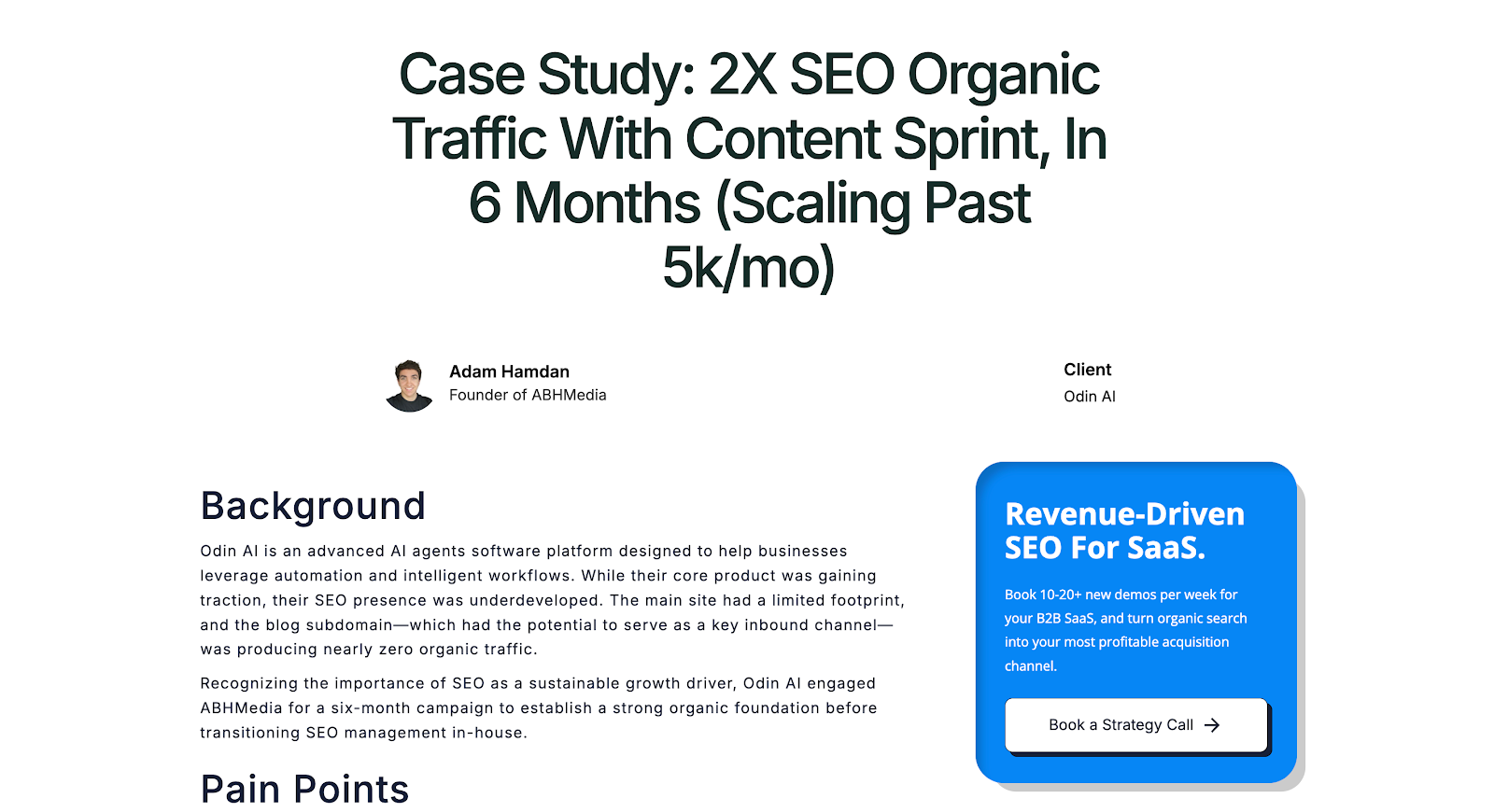
Here's a sample case study from ABHMedia.
Comparison Pages
Comparison pages include “vs” and “alternative” content. These pages target buyers who are actively evaluating options.
They already know they need software to solve their pain points. Now, they want to choose the right fit.
Write content about "(your brand) vs. (competitor)" or "best alternatives to (competitor)."
Compare features, pricing, integrations, and support in detail.
Use tables to make information easy to scan. Highlight where your product performs better, but avoid attacking competitors. Focus on clarity and value.
Include frequently asked questions that address common objections. And don't forget to add social proof, such as ratings or testimonials, to influence purchasing decisions.
Blog Posts
Blog posts are one of the most common content types in SaaS content marketing. According to the Content Marketing Institute, 92% of B2B marketers use short articles or posts.
Blogs help you target keywords at every stage of the funnel. However, they are most effective in attracting users at the top of the funnel. These are problem-aware readers searching for answers, not products.
You can publish educational guides, how-to articles, and industry explainers that address their pain points.
To write effective blog posts, focus on search intent and clarity. Use simple headings and short paragraphs. Provide clear, practical answers.
Then, guide readers deeper into your funnel. Add internal links to use case pages, comparison pages, and product features. Include soft calls to action like "learn how our software solves this" or "see how it works."
Each post should educate first, then move readers toward your SaaS solution.
6. Develop a Content Calendar
A content calendar helps you plan and prioritize your content marketing efforts. Instead of writing randomly, you follow a clear sequence based on goals and SaaS marketing funnel stages.
First, list your target keywords and group them by topic and intent.
Next, decide which pieces to write first. Focus on bottom-of-funnel pages early, then support them with blog posts and other supporting content.
You should also follow a consistent content creation schedule. Writing one post per week may be too slow for competitive SaaS markets.
Aim for a minimum of two or three high-quality articles per week. This builds momentum and faster organic growth.
7. Integrate Your SaaS Product Naturally Into Your Content
Write content that doesn't sound like a sales pitch. You can do that by identifying topics where your product fits naturally into the discussion. This makes your messaging more credible and improves lead generation.
For example, you can address real-life challenges your ICP faces. Avoid generic "how-to" guides that could apply to any business. Focus on specific workflows, pain points, and industry scenarios where your SaaS product plays an important role.
You can also review questions asked by your customers during sales calls and demos. These questions often reveal gaps in understanding. Turn them into blog posts, comparison pages, or tutorials.
When you connect your SaaS product to practical solutions, readers see clear value. That makes them more likely to explore your site and take the next step.
8. Outline Your Content Distribution Strategy
Writing a high-quality article is only half the job. You must actively promote it in multiple marketing channels.
Choose the right platforms where your target audience reads content. This may include LinkedIn, email newsletters, YouTube, industry forums, or partner sites.
Adapt each piece of content to fit a specific marketing channel. You can repurpose existing blog posts into short LinkedIn insights, email summaries, or short video clips.
Then, consider using a marketing automation platform to publish articles on your website and schedule social media posts in advance. This saves valuable time and keeps your output consistent.
9. Track Results and Make Adjustments
Monitor your content's performance to see whether your efforts are driving results.
Set up a reporting system that tracks key performance indicators, such as blog traffic, keyword rankings, demo requests, trial signups, and conversion rates. Use marketing analytics software (e.g., Google Analytics) or customer relationship management (CRM) software to collect data.
Review your numbers monthly. Identify which pages attract qualified traffic and which ones drive conversions.
If certain articles bring organic traffic but no leads, improve the calls to action or internal links.
If pages are not ranking, update the content and optimize keywords. You may also need to conduct technical SEO audits to identify issues in your website or hosting provider.
Use data to make informed decisions and small adjustments over time. Doing so can lead to better returns from your content marketing efforts.
10. Update and Optimize Content Regularly
Publishing your content once is not enough because Google rankings change, competitors update their content, and your product also adds new features.
If you do not refresh your content, your website's rankings can drop. You lose potential leads and clients.
It's important to review and update important pages at least every three to six months. Improve keyword targeting, update statistics, add new sections, and strengthen internal linking.
You should also pay attention to articles stuck on pages two or three of Google search results. Optimizing content can quickly improve your rankings.
One clear example is this case study of TapClicks.
TapClicks, a marketing analytics and reporting platform, already had steady website traffic.
However, existing blog posts were not fully optimized for organic search performance. Keywords were also sitting on pages two or three of Google. That means they were missing high-intent visibility.
TapClicks partnered with ABHMedia for a focused content refresh sprint. Our SaaS SEO agency optimized existing content to align with modern search intent, improve keyword targeting, and strengthen topical authority.
Within 90 days, TapClicks' rankings improved quickly, with more than 20 keyword position gains and 14 new page 1 rankings.
Book a strategy call today to learn more about SaaS content refresh strategies.
Should You Hire an In-House Content Marketing Team or a Content Marketing Agency?
There are two main ways to execute your SaaS content marketing strategy. You can build an internal team or partner with an external agency. Each option has pros and cons.
Hiring an In-House SaaS Content Marketing Team
An internal content team works solely for your SaaS company. They communicate closely with leadership, product, and sales teams. That means they can fully understand your brand voice, roadmap, and internal goals.
However, building an in-house SaaS content marketing team takes time and budget. You may need to hire an SEO strategist, a content manager, writers, and editors. Their salaries, tools, and training add up.
You may even find it difficult to find content professionals with SaaS-specific experience.
Only hire in-house when you have steady revenue, long-term content goals, and the budget to support multiple roles.
Hiring a SaaS Content Marketing Agency
A SaaS marketing agency helps you develop and execute a content strategy faster without building an internal team from the ground up.
You avoid long hiring cycles and onboarding delays. Instead, you get a complete team of content managers, writers, editors, and strategists from day one.
SaaS content marketing agencies also bring their experience from working with other SaaS companies. They understand keyword strategy, buyer intent, and how to attract the relevant traffic to your website.
Costs are more predictable than hiring multiple full-time employees. You can often save on tools, training, and management time.
Hire a SaaS content marketing agency when you lack internal resources and knowledge or want expert support to scale your content strategy.
Partner With ABHMedia for Revenue-Driven SaaS SEO and Content Marketing
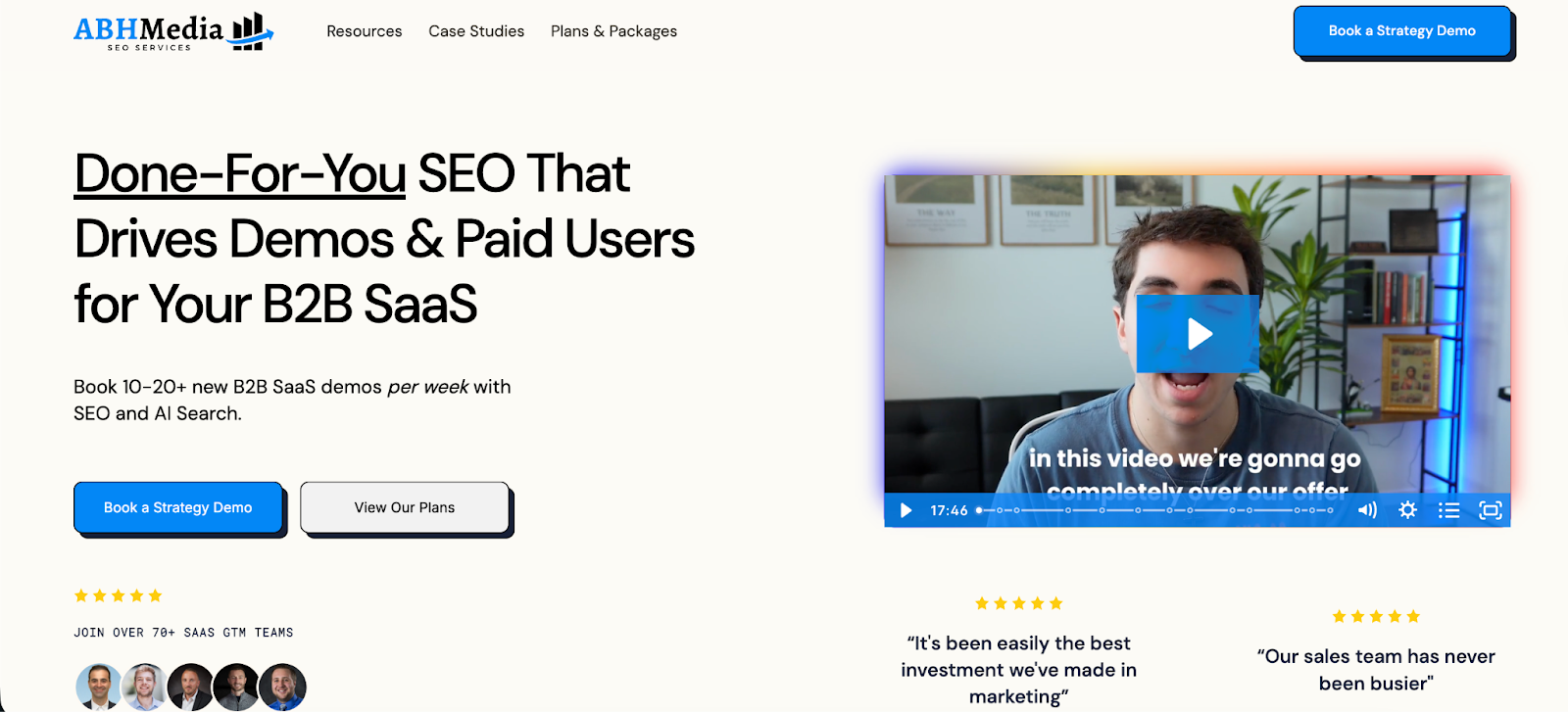
ABHMedia is a SaaS SEO agency that develops content strategies that drive revenue, not just traffic. We work with B2B SaaS companies that want profitable growth from organic search.
Our approach is ROI-driven. We focus on qualified sign-ups, demos, trial sign-ups, and paid users instead of vanity metrics.
We do that by targeting keywords with commercial or transactional intent and developing content that gets you qualified traffic.
Then, we combine technical SEO and link-building strategies to build an organic acquisition machine for your SaaS company.
Want to book 10-20 new B2B SaaS demos per week? Book a strategy call!
FAQs About SaaS Content Marketing
What is the 3-3-2-2-2 rule of SaaS?
The 3-3-2-2-2 rule in SaaS refers to a growth benchmark for annual recurring revenue (ARR). It suggests that a healthy SaaS company should aim to triple ARR in the first two years (3x). Then, double it for the next three years (2x).
This model highlights the strong early growth expected from scalable SaaS businesses. It sets a clear revenue target and encourages founders to focus on consistent, repeatable growth year over year.
What is the 70-20-10 rule in content marketing?
The 70-20-10 rule in content marketing is about balancing content types.
Your content strategy should have 70% educational posts. These are "how-to" guides, blog posts, and resources that answer common questions and solve daily problems.
Around 20% must be advanced content to build authority and target more informed buyers. Examples include in-depth case studies, expert insights, original research, and industry trends.
The final 10% can test new formats or bold ideas. It could be experiments with new marketing channels, creative email marketing campaigns, or unique content angles.
What are the five C's of content marketing?
The five C’s of content marketing are clarity, consistency, creativity, connection, and conversion.
- Clarity: Keep your message simple and easy to understand. Readers should quickly know what you offer and who it is for.
- Consistency: Publish content on a regular schedule to build trust and keep your brand visible.
- Creativity: Differentiate your company from others and give your brand a unique voice.
- Connection: Create content that addresses pain points and resonates personally with the audience.
- Conversion: Guide readers toward action, such as signing up, booking a demo, or starting a trial.
What does SaaS content mean?
SaaS content refers to blog posts, case studies, landing pages, videos, infographics, and other materials created to market and support a Software-as-a-Service product. It helps attract potential users, educate prospects, and encourage them to sign up or book demos.
SaaS content also supports existing customers with tutorials, product updates, and webinars. The goal is to drive growth and retention through useful information.




.png)