SEO Forecasting: How to Predict Traffic and Revenue
,
November 9, 2026
SEO forecasting estimates the organic traffic, leads, and revenue your SEO efforts could generate over the coming months.
You build it from your own historical data and the search demand behind your keywords, so the projection rests on real numbers instead of a guess.
No forecast can promise exact results, since algorithm updates and AI Overviews can shift your traffic at any time. That’s why a reliable forecast uses several scenarios and changes as actual data comes in.
In this guide, you’ll learn how to do SEO forecasting step by step, which methods and tools to use, and how to calculate traffic and ROI forecasts.
TL;DR
- SEO forecasting estimates how much organic traffic and revenue your website can get from search over the next 6 to 12 months, based on historical data and keyword research.
- The basic forecast multiplies each keyword’s monthly search volume by the expected CTR for its target position, and your conversion rates then turn that traffic into leads and revenue.
- AI Overviews can reduce organic clicks. Use recent CTR data and avoid applying an extra reduction when your baseline already reflects their effect.
- Three scenarios give stakeholders a realistic range, and a monthly check against actual results keeps the forecast accurate as new data comes in.
- ABHMedia helps B2B SaaS companies turn their SEO forecast into real growth, with buyer-intent content and backlinks that bring more demos and paid users from search.
What Is SEO Forecasting?
SEO forecasting is the process of estimating future organic traffic and the results that traffic can bring, based on past performance and current search data.
It answers one practical question for any business that invests in search: if the plan works as expected, how much traffic and how many sales will organic search deliver over a set period?
Most forecasts draw on two sources of data:
- Historical traffic data from Google Search Console and Google Analytics, which shows how your pages have performed so far.
- Keyword data, such as monthly search volume, your current ranking position for each term, and the average click-through rate at each position.
Your historical data shows the traffic you get today, and the keyword data shows the potential traffic you could reach once your rankings improve.
An SEO traffic forecast can cover the whole website or just one part of it, such as the blog or a group of product keywords.
Once you have the traffic estimates, you can add conversion rates and deal values to turn them into revenue projections, which are often what stakeholders want to see.
Why Is SEO Forecasting Important?
SEO takes months to show results, so most companies want a clear idea of the return before they commit to a monthly budget. A forecast gives them a planning range and supports several decisions along the way:
- Budget approval. A forecast connects your SEO investment to expected leads and revenue, which gives leadership a concrete reason to approve the SEO budget.
- Realistic expectations. Rankings and traffic grow slowly in the first months, and a forecast shows that curve upfront, so nobody judges the campaign a failure after month two.
- Channel comparison. You can value forecasted organic traffic at the cost of the same clicks in Google Ads, which shows how SEO stacks up against paid traffic over a full year.
- Work priorities. The forecast reveals which keywords and pages hold the most potential traffic, so it points your team to the tasks that belong at the top of your SEO roadmap.
- Progress checks. Each month you can hold actual data up against the forecast and spot early whether the strategy needs a change.
What Can You Forecast With SEO?
SEO forecasting goes beyond predicting website traffic. You can estimate several metrics that show how your organic search performance might affect business growth.
The most common SEO forecasting metrics include:
- Organic traffic: Estimate how many visitors your website could attract from search engines over the next 6 to 12 months.
- Keyword rankings: Predict how your target keywords might move in search results, based on where they rank today and the SEO work you have planned.
- Traffic value: Estimate what the same organic clicks would cost in Google Ads, a figure that Ahrefs reports as traffic value and SE Ranking as traffic cost.
- Conversions and leads: Forecast how many organic visitors might request a demo or complete another valuable action.
- SEO revenue: Estimate how much revenue organic search could bring, based on your conversion rates and deal values.
- SEO ROI: Set projected revenue against your SEO investment to estimate the potential return.
For example, a B2B SaaS company might forecast 10,000 monthly organic visits, which at its usual conversion rates would mean around 200 demo requests and 20 new customers.
How to Do SEO Forecasting in 6 Steps
A reliable forecast follows a clear order, from goals to data to the final numbers. The six steps below work for a whole website or for a single section, such as your blog or product pages.
Step 1: Define Your SEO Goals and Timeline
First, decide what you want your SEO forecast to measure, whether that is more qualified leads or a clear estimate of the revenue SEO could bring. Your goals determine which metrics you track and what data goes into the forecast.
For example, a B2B SaaS company might set these goals:
- Increase monthly organic traffic from 5,000 to 10,000 visits.
- Bring in 100 additional demo requests per month.
- Estimate the revenue potential of those new leads.
Next, choose your forecasting period. Most businesses use a 6- or 12-month SEO forecast because organic growth takes time, especially for new websites or competitive keywords.
Your goals should also match your business priorities. If your main objective is more customers, a forecast that stops at traffic won’t give you the full picture.
Step 2: Collect Historical Traffic Data From Multiple Data Sources
Your own past performance is the most reliable base for any forecast, so pull at least 12 months of data, or 16 if you have it, since that is the full history Google Search Console keeps.
A full year shows your seasonal peaks and dips, and without it, a normal summer slowdown can look like a decline.
Each tool provides different information, so collect data from multiple data sources:
- Google Search Console: Impressions, clicks, average position, and click-through rate for reported pages and queries.
- Google Analytics 4: organic sessions and the conversions they bring, which link traffic to business results.
- Your CRM: lead-to-customer rates and average deal values, which SEO tools can’t see.
- Third-party data: estimates from tools such as Ahrefs or Semrush, which fill gaps in your own data and show how competitors perform.
Before you use the numbers, clean the historical data. Check that conversion tracking worked across the whole period and mark any big events, such as site migrations or Google core updates.
Also split branded from non-branded traffic, since growth in branded searches usually comes from brand awareness and not from SEO work.
Step 3: Research Keywords and Search Volume Data
Historical data shows where you stand today, and keyword research shows where you can grow. Build a list of target keywords for the pages you plan to create or improve.
Focus on bottom-of-funnel keywords with clear buying intent, such as comparisons and alternatives, since they bring the visitors most likely to convert.
For each keyword, collect the following search volume data:
- Monthly search volume: how many times people search for the term each month, from tools such as Ahrefs, Semrush, or Google Keyword Planner.
- Current position: where your site ranks today, taken from Search Console.
- Keyword difficulty: how hard the term is to rank for, which keeps your target positions realistic.
- AI Overview presence: whether Google shows an AI Overview for the term, since those keywords bring far fewer clicks.
Keep in mind that keyword search volume from third-party tools is an estimate, and different tools often report different numbers for the same term.
Use one tool for all the keywords in the forecast so the numbers stay consistent, and check the totals against the impressions you see in Search Console.
Step 4: Estimate Future Rankings and Organic Traffic
Use your keyword data to estimate future rankings and the organic traffic they could bring over 6 to 12 months. Map expected ranking improvements month by month to build your traffic forecast.
Start with keywords you already rank for. A move from position 8 to position 3 is often more realistic than a new page that reaches the top spot for a competitive keyword.
To estimate organic traffic, multiply each keyword’s monthly search volume by the expected click-through rate (CTR) for its target ranking position.
Forecasted organic clicks = Monthly search volume × Expected CTR
For example, if a keyword gets 5,000 monthly searches and you expect a 10% CTR, that keyword could bring around 500 clicks per month.
Build a site-specific CTR baseline by grouping comparable Google Search Console queries by average position. Calculate each group’s click-through rate from total clicks divided by total impressions.
If your CTR data already reflects AI Overviews, do not apply another reduction. Use a separate adjustment only when the baseline excludes their effect.
According to Ahrefs, the presence of an AI Overview was linked to a CTR drop of 58% at position one, 46.4% at position three, and 19.4% at position ten.
If the keyword above shows an AI Overview and your target is position three, the estimate drops from 500 to roughly 270 clicks per month.
Repeat the calculation for your target keywords, then combine the results into a total organic click forecast. Check for overlapping keyword estimates to avoid double-counting.
Step 5: Forecast SEO Conversions, Revenue, and ROI
Connect your organic traffic forecast to leads, customers, and revenue using your historical conversion rates.
Use Google Analytics to calculate leads per organic session. Convert projected Google clicks into estimated sessions using your historical sessions-to-clicks ratio for matching dates and traffic sources.
Forecasted conversions = Forecasted organic sessions × Session-based conversion rate
For example, if your forecast predicts 10,000 monthly organic sessions and your conversion rate is 2%, you could expect around 200 conversions per month.
For B2B SaaS companies, apply your historical lead-to-customer rate to estimate new paying customers. If 10% of those 200 leads become customers, that’s 20 new customers each month.
With an average first-year customer value of $5,000, those 20 new customers represent $100,000 in projected revenue over their first year. That is not revenue earned in one month.
You can then estimate SEO ROI with this formula:
SEO ROI = ((SEO-attributed revenue − SEO investment) / SEO investment) × 100
Compare revenue and costs over the same period, and use actual sales conversion rates and customer values from your CRM rather than assume that every lead becomes a customer.
B2B deals also close weeks or months after the first demo, so revenue in your forecast should trail traffic by the length of your average sales cycle.
Step 6: Build Conservative, Realistic, and Optimistic Scenarios
SEO forecasts are never exact, since rankings shift as competitors publish new content and Google updates its algorithm. A single prediction suggests more precision than SEO can offer.
Build three SEO forecasting scenarios instead:
- Conservative scenario: Assumes slower ranking gains and a heavier cut for AI Overview keywords.
- Realistic scenario: Builds on historical performance and the SEO work you have planned.
- Optimistic scenario: Assumes all target positions are reached on schedule.
For example, if your website currently receives 5,000 organic visits per month, your 12-month forecast might look like this:
These are illustrative projections, not standard SEO growth rates.
Three scenarios give stakeholders a clear view of the possible outcomes, so nobody treats your SEO forecast as a guarantee.
The realistic scenario usually works best as the main plan, and the conservative one shows what results could look like if rankings grow more slowly than expected.
Once your forecast is ready, compare it with actual performance every month and update your assumptions as new data comes in.
SEO Forecasting Methods
The six steps above follow one approach, but there are three main ways to forecast SEO traffic, and each one fits a different situation. Many teams use two of them together, with a historical forecast as the baseline and a keyword-based forecast to show the extra gain from new work.
Historical Traffic Trends Forecasting
Historical SEO forecasting uses your website’s past organic traffic to estimate future growth.
For example, if your organic traffic has grown by an average of 5% per month, you can use that growth rate as a starting point to project traffic over the next 6 to 12 months.
This method works best for established websites with consistent traffic and at least 12 months of historical data.
It assumes past trends will continue, so it becomes less reliable after big changes, such as a new SEO strategy or a major ranking drop.
Keyword-Based SEO Forecasting
A keyword-based forecast takes the search volume of each target keyword and the click-through rate of the position you expect to reach, and turns them into an estimate of future organic traffic.
For example, if you target a keyword with 3,000 monthly searches and expect to reach a position with an 8% CTR, you could forecast around 240 monthly clicks. Repeat this calculation across your target keywords to estimate the traffic potential of your SEO campaign.
This method is most useful when you plan new content or want to estimate the impact of ranking improvements.
The main limitation is that rankings and CTRs are difficult to predict, especially now that AI Overviews and other Google Search features take clicks away from organic results.
Competitor-Based SEO Forecasting
Competitor-based forecasting uses the organic search performance of competing websites to estimate your own growth potential.
With Ahrefs or Semrush, you can see a competitor’s estimated organic traffic and the keywords that bring it.
For example, if a competitor gets an estimated 10,000 monthly organic visits from a group of topics you haven’t covered, you can use that data to assess the potential opportunity for your website.
This method is useful for newer websites with limited historical data or businesses that enter a competitive market.
Competitor traffic figures from SEO tools are estimates, not actual analytics data. Use them as a benchmark rather than a guaranteed traffic target.
Best SEO Forecasting Tools in 2026
You can build a solid forecast with free tools and a spreadsheet, but SEO forecasting software saves time and adds data you can’t collect on your own. Most teams use a mix of the tools below.
Google Search Console and Google Analytics 4
Google Search Console shows how your pages perform in Google search, and Google Analytics 4 shows what visitors do once they reach your site.
Search Console shows the real click-through rate your site gets at each position, and GA4 adds the organic conversion rate you need to turn forecasted traffic into leads.
Both tools are free and use your own data, which makes them the most reliable starting point for any forecast.
The limitation is that neither tool can estimate traffic for keywords your site doesn’t appear for yet, so you need a third-party tool for new topics.
Ahrefs

Ahrefs is an SEO platform for keyword research and competitor analysis.
Its Traffic Potential metric shows how much traffic the top-ranking page for a keyword gets from all the keywords it ranks for. This gives you a more realistic target than the search volume of a single keyword.
You can also check the organic traffic history of any website, which is useful for competitor-based forecasts.
Keep in mind that Ahrefs traffic figures are estimates, so they won’t match your Search Console data exactly.
Semrush
Semrush is an all-in-one SEO platform that adjusts keyword data to your own domain.
Personal Keyword Difficulty shows how hard a keyword is for your website to rank for, and Potential Traffic estimates how many visits your site could get from that keyword.
For example, two websites can see different difficulty scores for the same keyword, depending on their authority and topical relevance.
Semrush traffic predictions are also estimates, so check them against your own Search Console data before you use them in a forecast.
SE Ranking
SE Ranking has an SEO Potential tool that does most of the forecasting math for you.
You add your target keywords with the position you expect to reach, then enter your conversion rate and value per conversion. Based on that, the tool estimates how much organic traffic you could get and how many leads it could bring.
If you set the target position to 1, you can see the maximum traffic your keyword list could bring, which works well for the optimistic scenario.
The results depend on the positions you enter, so set realistic targets for the conservative and realistic scenarios.
SEOmonitor
SEOmonitor is SEO forecasting software built mainly for agencies.
You choose keyword groups with their target rankings, and the tool estimates the extra non-branded sessions and revenue you could get month by month.
Its forecasts account for seasonal search trends and SERP features that reduce clicks, and a Chance Indicator shows how realistic your goals are.
After the campaign starts, you can track actual performance against the forecast inside the tool.
Google Sheets and Excel
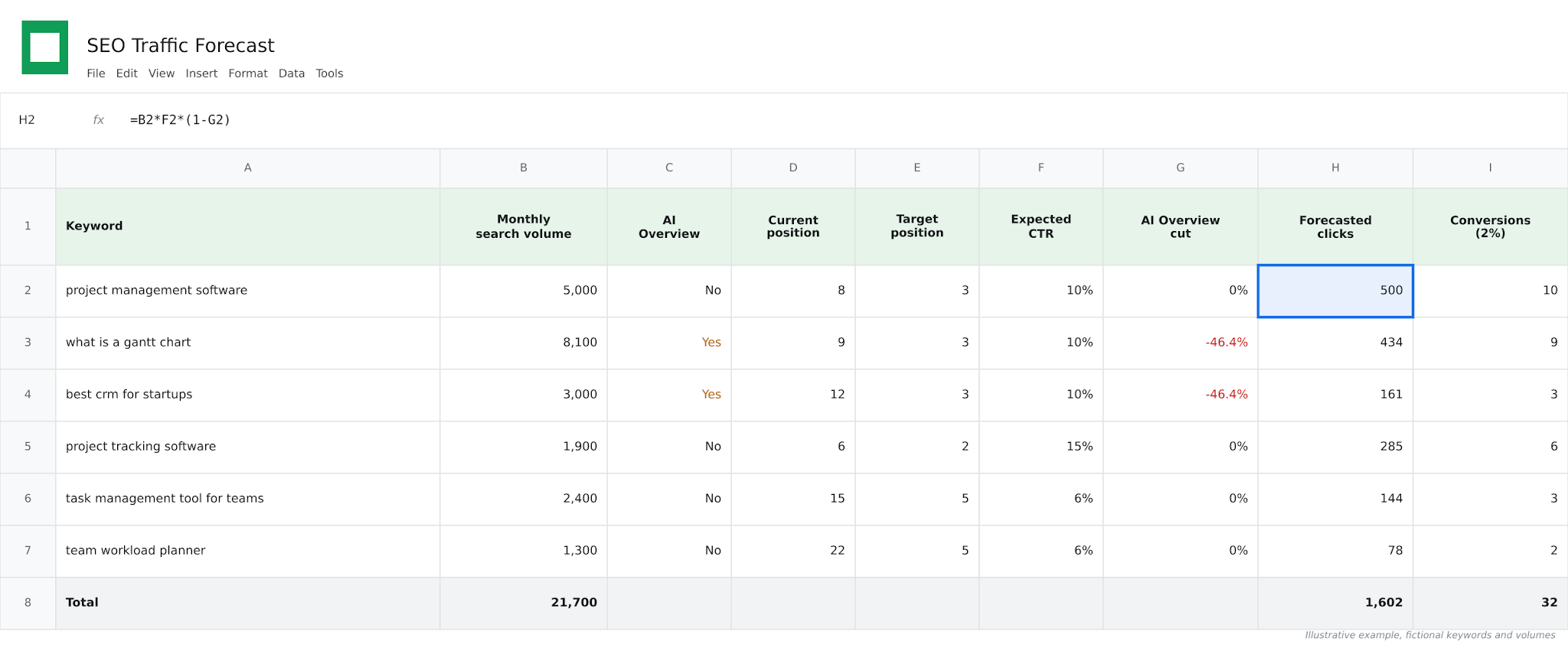
Google Sheets and Excel give you full control over every assumption in your forecast.
You can combine Search Console data with keyword estimates and build all three scenarios side by side.
For simple trend forecasts, the FORECAST.LINEAR function works in both tools, and FORECAST.ETS in Excel also accounts for seasonality.
The downside is that spreadsheets require manual updates, and one broken formula can affect the entire forecast.
How to Calculate SEO Traffic and ROI Forecasts
You don't need advanced statistical models to calculate basic SEO forecasts. A few formulas can help you estimate how much traffic and return on investment your SEO strategy could bring.
SEO Traffic Forecasting Formula
The simplest way to forecast organic traffic is to multiply a keyword’s monthly search volume by the expected click-through rate (CTR) for its target ranking position.
Forecasted organic clicks = Monthly search volume × Expected CTR
For example, let’s say you’re targeting a keyword with:
- Monthly search volume: 2,400
- Expected ranking position: 2
- Estimated CTR: 15%
Your forecast would be:
2,400 × 0.15 = 360 monthly organic clicks
If your baseline CTR excludes the effect of AI Overviews, test a separate adjustment:
Forecasted organic clicks = Monthly search volume × Expected CTR × (1 − AI Overview CTR drop)
Using the 50.8% reduction reported by Ahrefs as an illustrative assumption, the estimate becomes about 177 monthly clicks (2,400 × 0.15 × 0.492).
Repeat this calculation for your target keywords to estimate total organic clicks. Make sure you account for overlapping keywords and use realistic CTR estimates based on recent search data.
You can also use historical traffic growth to create a simpler forecast:
Forecasted traffic = Current traffic × (1 + Monthly growth rate)^Number of months
If your website receives 5,000 monthly organic visits and grows by 5% each month, your forecast after six months would be approximately 6,700 monthly visits.
SEO Revenue and ROI Forecasting Formula
Once you’ve estimated organic traffic, you can calculate how much revenue that traffic could generate.
Start by estimating conversions:
Forecasted conversions = Forecasted organic sessions × Session-based conversion rate
For example, if you forecast 8,000 organic sessions over 12 months with a 1.5% conversion rate, that’s 120 leads.
For a B2B SaaS company, you can then estimate how many leads will become paying customers.
Forecasted revenue = Forecasted leads × Lead-to-customer rate × Average customer value
If 15% of those 120 leads become customers, that’s 18 new customers. Assuming each contributes an average of $6,000 within that reporting period, projected revenue totals $108,000.
Finally, calculate SEO return on investment:
SEO ROI = ((SEO-attributed revenue − SEO costs) ÷ SEO costs) × 100
If SEO costs total $24,000 during those same 12 months, the revenue-based return is:
SEO ROI = (($108,000 − $24,000) ÷ $24,000) × 100 = 350%
This revenue-based calculation leaves $3.50 after SEO costs for each $1 invested. It does not measure net profit.
Keep in mind that these are simplified calculations. For a more reliable SEO ROI forecast, use incremental revenue attributable to SEO, include all relevant SEO costs, and account for sales cycles and customer acquisition timelines.
Common SEO Forecasting Mistakes to Avoid
Even a forecast built on good data can miss by a wide margin if a few common mistakes slip in.
Overestimating Rankings and Organic Traffic
One of the biggest SEO forecasting mistakes is assuming every target keyword will reach the top three positions on Google.
Not every page will rank that high, especially when you compete against established websites with stronger backlink profiles.
How to avoid it: Base each ranking prediction on where the page ranks today and how difficult the keyword is. Use conservative estimates for highly competitive keywords.
Using CTR Data From Before AI Overviews
Older SEO forecasting models often rely on CTR studies that don’t account for Google AI Overviews.
Today, users can get answers directly in search results without clicking a website. This means even a high-ranking page might receive fewer clicks than historical CTR data suggests.
How to avoid it: Use recent CTR data and check whether your target keywords trigger AI Overviews. Apply a separate reduction only if your CTR baseline excludes their effect.
Ignoring Seasonality and Google Algorithm Updates
Search demand isn’t the same throughout the year. Some industries see predictable traffic increases during certain months, while others see seasonal declines.
Google algorithm updates can also change rankings and organic traffic, which makes historical growth trends less reliable.
How to avoid it: Review at least 12 months of historical traffic data to identify seasonal patterns. Build different forecasting scenarios to account for unexpected ranking changes.
Treating SEO Forecasts as Guaranteed Results
An SEO forecast is an estimate, not a promise that your website will reach a specific traffic or revenue target.
Search rankings depend on many factors outside your control, from competitor activity to Google updates.
How to avoid it: Present three scenarios instead of a single number. Explain the assumptions behind each one so stakeholders understand the potential outcomes.
Failing to Update Your SEO Forecast
SEO forecasting isn’t something you should do once and forget about.
As you publish new content and collect more performance data, your original projections may become outdated.
How to avoid it: Review your forecast every month and compare projected results against actual performance. Update your assumptions when performance changes so your forecast stays useful for planning.
Turn Your SEO Forecast Into Real Growth With ABHMedia

A forecast shows what SEO could bring, but the harder part is the work that turns those numbers into demos and customers.
ABHMedia is a B2B SaaS SEO agency that works only with software companies. Every campaign starts with a strategy call about your product and the customers you want more of, and that conversation shapes the keyword plan.
The team focuses on searches with clear buying intent, since those visitors are the closest to a demo, and handles the full SaaS content production process for the pages that target them.
To push those pages higher, ABHMedia places 5 to 30 hand-picked backlinks on relevant sites each month through SaaS link building, depending on the plan.
Results appear in a live reporting dashboard that tracks the SEO KPIs behind your forecast, so you can check progress against it every month. For TextUs, this approach brought a 42% increase in organic traffic within three months.
FAQs About SEO Forecasting
How accurate is SEO forecasting?
SEO forecasting accuracy depends on the quality of your inputs, so a forecast built on clean historical data and recent CTR data lands much closer to actual traffic than one based on industry averages.
The best way to improve SEO forecasting accuracy is to compare your projections with real results every month and adjust the assumptions that missed.
How do you calculate SEO ROI?
To calculate SEO ROI, subtract SEO costs from organic search revenue, divide by those costs, and multiply by 100.
Estimate revenue using orders × average order value for ecommerce, or new customers × customer value for B2B. Include all campaign costs when reviewing SEO services pricing.
How far ahead should you forecast SEO growth?
Forecast SEO growth 6 to 12 months ahead. Use quarterly checkpoints to set realistic expectations and compare future traffic with your projections. An SEO prioritization framework helps determine which pages to work on first.
Can technical SEO issues affect your forecast?
Yes, since pages that Google can’t crawl or index won’t rank no matter how strong the content is. Run through an SEO audit checklist before you build the forecast, and fix the major technical SEO issues first so your organic search traffic has a fair chance to reach the projection.
Can you forecast SEO potential for a new website?
You can, but the traffic projection will rely on third-party SEO data instead of your own history. This is the usual situation in SEO for SaaS startups, where you study how fast similar competitors grew and use keyword data to estimate the potential traffic gains for your target topics.
Treat that first forecast as a rough guide and update it once your site has a few months of real data.