SaaS Blog Strategy: 9 Steps to Drive Traffic & Leads
,
November 2, 2026
Publishing blog posts regularly doesn't mean your SaaS business will gain more customers. You might attract thousands of visitors. But if they aren't interested in your software, they won't turn into leads.
A quality SaaS blog strategy helps you find relevant keywords and create content that solves customer problems. It also helps turn organic traffic into qualified leads.
Most SaaS companies want visitors who will book demos or start trials and become paying customers. Unlike paid advertising, a well-planned blog can bring in potential customers over time without paying for every click.
This guide walks through nine practical steps to build a SaaS blog strategy. You'll learn how to research your audience, plan content, improve SEO, and track leads and conversions.
TL;DR
- A SaaS blog strategy helps you create content that attracts potential customers and turns readers into leads.
- Find relevant keywords based on your ideal customers' needs and search intent.
- Publish helpful guides and product-led content that bring organic traffic and encourage trials or demos.
- Focus on reaching the right B2B SaaS audience and track qualified leads, signups, and conversions, not just traffic.
- ABHMedia helps B2B SaaS companies with buyer-intent keyword research, SEO content creation, link building, and conversion tracking to turn blog traffic into qualified leads.
How to Create a SaaS Blog Strategy in 9 Steps
A SaaS blog strategy connects your customers' problems with useful content and business goals. It helps you choose topics based on search intent and create articles that bring potential buyers closer to your software.
Here are nine steps to build a B2B SaaS blog strategy that drives organic traffic and qualified leads:
1. Define Your SaaS Blog Goals and Ideal Customer
Start by identifying who you want to reach and what action you want them to take after reading your blog. Focus on people who need the solutions your SaaS product offers.
To better understand your target audience, look at their daily challenges and buying needs. This will help you choose blog topics that answer their questions and bring the right people to your website.
Next, use these findings to set clear goals for trial signups and demo requests. Focus on generating qualified leads who are likely to become paying customers.
You should also monitor customer acquisition cost (CAC) and customer lifetime value (CLV). These figures show whether your marketing strategy brings in customers who generate revenue over time.
2. Find Relevant SaaS Blog Keywords Based on Search Intent
Find keywords based on what potential customers search for before choosing software. Focus on topics that match your SaaS product and its use cases instead of chasing popular searches.
You can use Ahrefs to find relevant keywords and check their search volume and ranking difficulty. Then review Google Search Console to see which queries already bring impressions and clicks to your website.
You can also use free tools like Google Keyword Planner to identify related searches.
Next, group your keywords by search intent:
- Informational: "How to manage multiple client projects" targets people looking for guidance.
- Commercial: "Best project management tools for agencies" targets buyers comparing software.
- Transactional: "[Tool] pricing" targets people closer to signing up.
Each type serves a different purpose in your SaaS SEO strategy.
Informational queries help people learn about your SaaS brand. Commercial searches attract potential buyers who are closer to making a purchase.
Review the top search results before choosing a topic. See whether people are looking for a tutorial or a comparison page. They may also want a template or product page.
3. Prioritize SaaS Blog Topics Based on Business Value
Once you have your keyword list, choose which topics to focus on first. High search volume doesn't always mean an article will bring in the right buyers or support customer acquisition.
A practical approach is to score each keyword using four factors:
- Product relevance: Does your software solve the problem behind the search?
- Buyer intent: Is the reader researching a problem or evaluating a solution?
- Ranking opportunity: How difficult would it be to compete with the current pages?
- Conversion potential: Can the topic lead naturally to a product marketing, trial, or demo?
Rate each factor from one to five and add up the scores. Prioritize topics that match your product and show strong buyer intent, even if they have lower search volume.
For example, consider these hypothetical opportunities:
These priorities assume the company sells project management software to agencies. Your actual ranking opportunities may change the order.
This process keeps your SaaS content marketing focused on problems your software can address.
4. Choose SaaS Blog Content Types for Each Buyer Stage
Choose SaaS blog content types based on where readers are in the buying process.
Someone learning about a problem needs helpful advice. A buyer comparing software options needs more detail to decide.
Start by mapping your content to three sales funnel stages.
- Top of the funnel (TOFU): Publish educational blog posts and how-to guides that answer common questions. You can also share practical resources like project planning templates to help readers solve problems before they start looking for software.
- Middle of the funnel (MOFU): Create product-led content and workflow tutorials that show how your software solves specific problems. You can also use case pages to help readers compare different solutions and decide if they need a dedicated tool.
- Bottom of the funnel (BOFU): Publish comparison pages and competitor alternatives to reach buyers ready for action. Add detailed product tutorials and verified customer testimonials to help them choose the right software.
For product launches, write articles that show how new features solve real problems.
Focus on giving readers relevant information at each stage. Your educational content should help them make decisions without feeling like a sales pitch.
5. Build SaaS Blog Topic Clusters and Internal Links
Topic clusters group related blog posts around one main subject. They help readers find more useful information and show search engines how your content connects.
Start with a pillar page that covers a topic related to your SaaS product. For example, a project management company could create a page called “project management for agencies.”
Supporting articles might cover “how to create a project timeline,” “how to assign tasks for multiple teams,” “how to manage client approvals,” and “best project management software for agencies.”
Each supporting article should link to the pillar page using descriptive anchor text. The pillar page can then point readers toward detailed guides that answer their next questions.
Where appropriate, add internal links to related product pages or free tools.
Before creating another article, review your existing content. Two pages targeting the same search intent may compete for similar queries without offering readers much additional value.
You can refresh an old post, merge articles covering similar topics, or write something new if it answers a different question.
6. Create a SaaS Blog Content Calendar You Can Maintain
A content calendar helps your team turn selected topics into a clear publishing schedule. It also keeps research, writing, review, and publication on track.
Include these details for each planned article:
- Target keyword: The main search query.
- Search intent: What the reader wants to know or do.
- Content format: Tutorial, comparison, guide, or product-led article.
- Owner and deadline: Who writes, reviews, and publishes the post.
- Conversion goal: The next action you want interested readers to take.
A small B2B SaaS team might start with a handful of blog posts a month. If your team has less time, focus on publishing fewer articles with better research and content quality.
Take your time to update existing content when your product changes or customers start searching for different information.
Before each article goes live, ask your sales team to review product claims and buying-related information. Their feedback can make your marketing content more accurate.
7. Write and Optimize SaaS Blog Posts for SEO and AI Search
Focus each article on one clear search intent and answer the main question early. This helps readers find what they need without wading through long explanations.
To improve content quality, follow these practices:
- Answer questions directly: Give a clear response before expanding on the details.
- Add first-hand insights: Include original examples, product screenshots, expert input, or research your team can verify.
- Use descriptive headings: Break complex topics into sections that answer specific questions.
- Support your claims: Link to credible studies, official documentation, and relevant data.
- Review on-page SEO: Write accurate titles, meta descriptions, and image alt text.
These steps can also improve your content's visibility in AI search results. This supports Answer Engine Optimization (AEO) and Generative Engine Optimization (GEO).
Google's guidance for generative AI search emphasizes original, useful content and established SEO practices. Clear writing can help readers and search systems understand your work.
But no format guarantees placement in AI answers.
Once your article is published, share it through email marketing, social media marketing, and relevant communities.
You can also support your SEO strategy through link building. Sharing original research and helpful templates gives other websites a reason to link to your content. Free tools can also help you earn authoritative backlinks.
Look for relevant sites that link to similar resources or have broken links to outdated guides. Reach out only when your content offers a useful replacement.
Focus on providing real value instead of relying on mass cold outreach or paid advertising alone.
8. Turn SaaS Blog Readers Into Qualified Leads
To generate leads from your B2B SaaS blog, give readers a clear next step that relates to the topic they're reading about.
For example, a post about meeting project deadlines could share practical tips for managing tasks. You can then show how your software makes that work easier and link to a feature page or free trial for readers who want to try it.
Match your CTAs to the reader's intent:
- Educational content: Offer an ungated checklist, template, or useful guide.
- Product-led tutorials: Link to the feature or workflow discussed in the article.
- Comparison pages: Offer a product demo, trial, or detailed feature comparison.
Keep your regular blog posts free to read. For original research or detailed templates, you can ask readers for their email.
Customer testimonials can also build trust. They show how others have used your software to solve real problems.
Unlike paid ads, relevant blog content reaches people searching for solutions. It helps them learn about your SaaS product before making a purchase.
This builds interest in your software without pushing readers to buy right away.
9. Measure SaaS Blog Performance and Improve Existing Content
Track both search performance and business results to see how well your blog is doing. Organic traffic matters, but it doesn't always mean you're attracting the right buyers.
You can use Google Search Console to review search impressions, clicks, queries, and average position. Google Analytics 4 helps track engagement and important actions, such as trial registrations or demo requests.
Customer relationship management (CRM) reporting identifies qualified leads, sales opportunities, and customers connected to blog visits.
Check how many blog visitors become leads. For example, 20 leads from 1,000 blog visits means a 2% conversion rate.
Next, compare your content costs with the results. Customer acquisition cost and customer lifetime value can help you see if your investment pays off. Just make sure you can track which customers came from your blog.
If an article loses rankings, check for outdated information or changes in search intent. If it attracts the right visitors but few leads, review your CTA to see if it matches their needs.
Check which posts keep readers interested and which websites send referral traffic. Look for your content in AI search results as well. Compare those mentions with your SEO performance and actual leads.
Use these findings to decide what each article needs. Some may need fresh information or more detail. Others may work better when combined into one post.
Leave articles that already perform well as they are before investing in more product-led content.
Common SaaS Blog Strategy Mistakes to Avoid
Even a well-planned SaaS blog strategy can fail when content doesn't match customer needs. Avoid these common mistakes:
- Chasing search volume: Target relevant keywords connected to your product, not broad topics that attract the wrong audience.
- Ignoring conversions: Educational content needs a natural path to product pages, trials, or demos.
- Publishing duplicate topics: Avoid creating posts that target the same search intent and repeat the same content.
- Neglecting older articles: Update outdated information and add internal links to useful resources.
- Measuring just traffic: Track qualified leads alongside organic traffic to judge business results.
For most SaaS companies, successful SaaS marketing means reaching potential buyers, not simply increasing pageviews.
Build a SaaS Blog Strategy That Generates Leads With ABHMedia
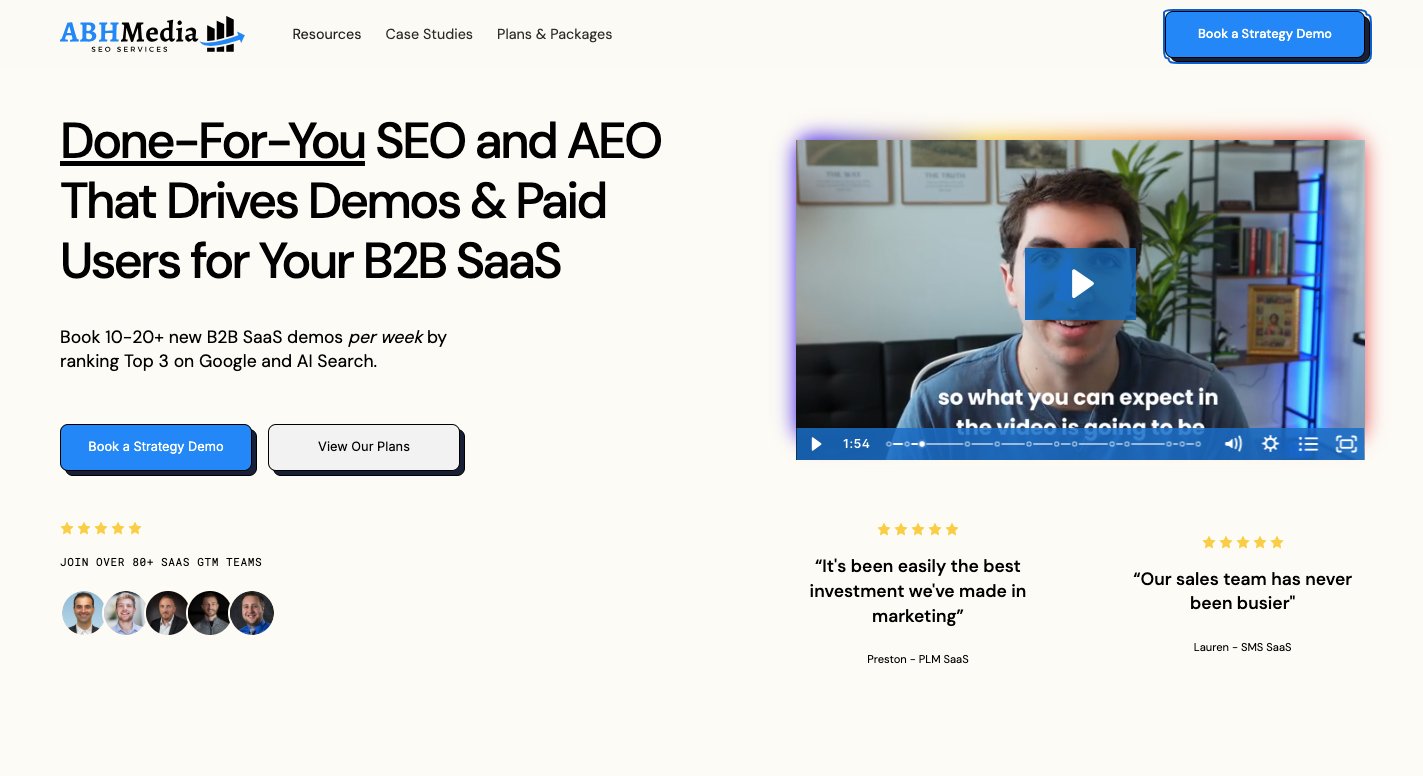
A SaaS blog strategy needs more than a list of topics. You need regular keyword research and quality content. You also need time to improve SEO and track results.
ABHMedia handles SEO and content marketing for B2B SaaS companies. The focus is on attracting the right visitors and turning them into qualified leads that book demos and become paying customers.
Here's how ABHMedia helps:
- Keyword and content strategy: Identifies buyer-intent keywords and builds a content roadmap around your ideal customers.
- SEO content creation: Produces relevant blog articles based on keywords that connect with your software and business goals.
- Content optimization: Improves existing pages through content rewrites, internal linking, and technical SEO.
- Link building: Builds relevant backlinks through outreach to authoritative websites in your niche.
- Conversion tracking: Tracks website performance, conversions, and SEO results through reporting dashboards.
Instead of managing every part of your SaaS SEO strategy in-house, you can work with the ABHMedia team to build an organic customer acquisition channel.
FAQs About SaaS Blog Strategy
How often should a SaaS company publish blog posts?
Start with two to four blog posts per month if your team has the resources. Focus on quality and use a content calendar to plan topics you can publish consistently.
How long does a SaaS blog strategy take to show results?
A SaaS blog strategy usually takes several months to bring in organic traffic. Results depend on your competition and website authority. Content quality and SEO efforts also affect how quickly you see progress.
How do you measure the ROI of a SaaS blog?
Compare your SaaS content production costs with the revenue your blog generates. Track qualified leads and paying customers through analytics and CRM data. You can also use customer acquisition cost and customer lifetime value to measure returns.